
Details
Summary
- Instrument:
- Cello Double Bass Piano
- Ensembles:
- String Orchestra
- Genres:
- Classical
- Composers:
- Larry Clark
- Publishers:
- Carl Fischer Music
- UPC:
- 798408047917
- ISBN:
- 9780825847912
- Format:
- Score Set of Parts Score and Parts
- Item types:
- Physical
- Artist:
- Larry Clark
- Usages:
- School and Community
- Main Key:
- D major
- Number of Pages:
- 73
- Size:
- 9 x 11.74 inches
- Shipping Weight:
- 1.25 pounds
Detailed Description
SKU: CF.FAS17
Composed by Larry Clark. Folio. Carl Fischer First Plus String Orchestra Series. Classical. Score and Parts. With Standard notation. 73 pages. Carl Fischer Music #FAS17. Published by Carl Fischer Music (CF.FAS17).ISBN 9780825847912. UPC: 798408047917. 9 x 11.74 inches. Key: D major.
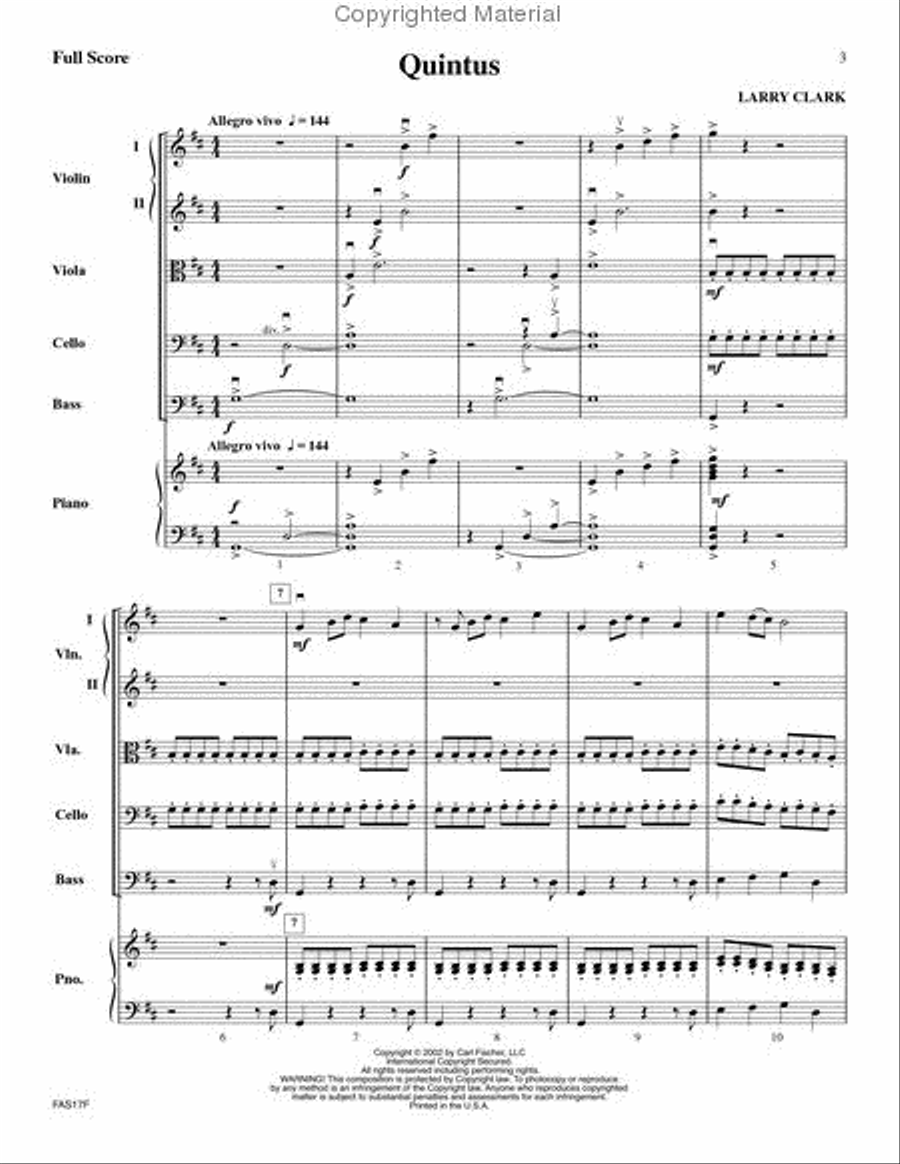
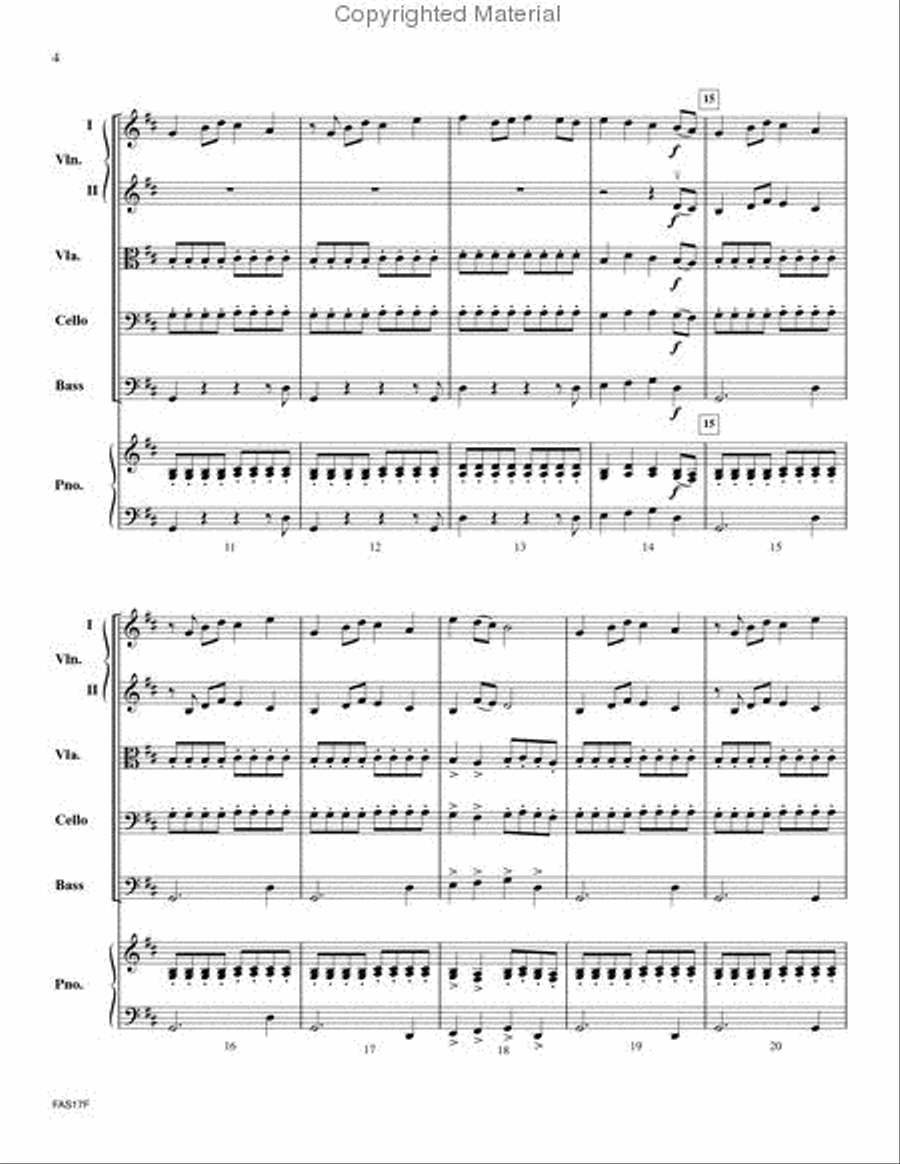
In the Middle Ages, Quintus was the Latin term for the fifth church mode, what today we call the Lydian mode. The church-mode system at that time consisted of eight scales formed from tones of the C-Major scale but starting and ending on D, E, F or G. Quintus also refers to the interval of a perfect fifth. The piece uses both the idea of a perfect fifth and the Lydian mode as the basis for the composition. The intervals of perfect fifth are first stated in the introduction, which is then followed by the main theme in the Lydian mode on G. The bridge melody at m. 23 is something of an inversion of the main idea. A sostenuto section that is based on the idea of stacked fifths follows this. The tempo, however, should not slacken. The elongated rhythmic values will give the feeling of rhythmic repose. After a short pause, the main theme is stated again. Following a repeat of the bridge section, the composition ends with an aggressive coda. It may be appropriate for the coda to have a slight accelerando to the end if you feel that it is musically appropriate for your situation. As with all of my piece, the tempo is merely a suggestion and should be adjusted to fit the needs of your students. It is hoped that this piece can be used to teach younger students about intervals and the idea of different modes in the construction of music. It has been my pleasure to have the opportunity to write this piece. I hope you and your students enjoy it and find it useful for your program. -Larry Clark New York, NY 2002.
In the Middle Ages, Quintus was the Latin term for the fifth church mode, what today we call the Lydian mode. The church-mode system at that time consisted of eight scales formed from tones of the C-Major scale but starting and ending on D, E, F or G. Quintus also refers to the interval of a perfect fifth. The piece uses both the idea of a perfect fifth and the Lydian mode as the basis for the composition. The intervals of perfect fifth are first stated in the introduction, which is then followed by the main theme in the Lydian mode on G. The bridge melody at m. 23 is something of an inversion of the main idea. AA sostenuto section that is based on the idea of stacked fifths follows this. The tempo, however, should not slacken. The elongated rhythmic values will give the feeling of rhythmic repose. After a short pause, the main theme is stated again. Following a repeat of the bridge section, the composition ends with an aggressive coda. It may be appropriate for the coda to have a slightA accelerando to the end if you feel that it is musically appropriate for your situation. As with all of my piece, the tempo is merely a suggestion and should be adjusted to fit the needs of your students. It is hoped that this piece can be used to teach younger students about intervals and the idea of different modes in the construction of music. It has been my pleasure to have the opportunity to write this piece. I hope you and your students enjoy it and find it useful for your program. -Larry Clark New York, NY 2002.
In the Middle Ages, "Quintus" was the Latin term for the fifth church mode, what today we call the Lydian mode. The church-mode system at that time consisted of eight scales formed from tones of the C-Major scale but starting and ending on D, E, F or G. "Quintus" also refers to the interval of a perfect fifth. The piece uses both the idea of a perfect fifth and the Lydian mode as the basis for the composition. The intervals of perfect fifth are first stated in the introduction, which is then followed by the main theme in the Lydian mode on G. The "bridge" melody at m. 23 is something of an inversion of the main idea. AA sostenuto section that is based on the idea of stacked fifths follows this. The tempo, however, should not slacken. The elongated rhythmic values will give the feeling of rhythmic repose. After a short pause, the main theme is stated again. Following a repeat of the "bridge" section, the composition ends with an aggressive coda. It may be appropriate for the coda to have a slightA accelerando to the end if you feel that it is musically appropriate for your situation. As with all of my piece, the tempo is merely a suggestion and should be adjusted to fit the needs of your students. It is hoped that this piece can be used to teach younger students about intervals and the idea of different modes in the construction of music. It has been my pleasure to have the opportunity to write this piece. I hope you and your students enjoy it and find it useful for your program. -Larry Clark New York, NY 2002.
In the Middle Ages, "Quintus" was the Latin term for the fifth church mode, what today we call the Lydian mode. The church-mode system at that time consisted of eight scales formed from tones of the C-Major scale but starting and ending on D, E, F or G. "Quintus" also refers to the interval of a perfect fifth. The piece uses both the idea of a perfect fifth and the Lydian mode as the basis for the composition. The intervals of perfect fifth are first stated in the introduction, which is then followed by the main theme in the Lydian mode on G. The "bridge" melody at m. 23 is something of an inversion of the main idea. A sostenuto section that is based on the idea of stacked fifths follows this. The tempo, however, should not slacken. The elongated rhythmic values will give the feeling of rhythmic repose. After a short pause, the main theme is stated again. Following a repeat of the "bridge" section, the composition ends with an aggressive coda. It may be appropriate for the coda to have a slight accelerando to the end if you feel that it is musically appropriate for your situation. As with all of my piece, the tempo is merely a suggestion and should be adjusted to fit the needs of your students. It is hoped that this piece can be used to teach younger students about intervals and the idea of different modes in the construction of music. It has been my pleasure to have the opportunity to write this piece. I hope you and your students enjoy it and find it useful for your program. -Larry Clark New York, NY 2002.
In the Middle Ages, "Quintus" was the Latin term for the fifth church mode, what today we call the Lydian mode. The church-mode system at that time consisted of eight scales formed from tones of the C-Major scale but starting and ending on D, E, F or G. "Quintus" also refers to the interval of a perfect fifth. The piece uses both the idea of a perfect fifth and the Lydian mode as the basis for the composition. The intervals of perfect fifth are first stated in the introduction, which is then followed by the main theme in the Lydian mode on G. The "bridge" melody at m. 23 is something of an inversion of the main idea. A sostenuto section that is based on the idea of stacked fifths follows this. The tempo, however, should not slacken. The elongated rhythmic values will give the feeling of rhythmic repose. After a short pause, the main theme is stated again. Following a repeat of the "bridge" section, the composition ends with an aggressive coda. It may be appropriate for the coda to have a slight accelerando to the end if you feel that it is musically appropriate for your situation. As with all of my piece, the tempo is merely a suggestion and should be adjusted to fit the needs of your students. It is hoped that this piece can be used to teach younger students about intervals and the idea of different modes in the construction of music. It has been my pleasure to have the opportunity to write this piece. I hope you and your students enjoy it and find it useful for your program. -Larry Clark New York, NY 2002.
In the Middle Ages, "Quintus" was the Latin term for the fifth church mode, what today we call the Lydian mode. The church-mode system at that time consisted of eight scales formed from tones of the C-Major scale but starting and ending on D, E, F or G. "Quintus" also refers to the interval of a perfect fifth.The piece uses both the idea of a perfect fifth and the Lydian mode as the basis for the composition. The intervals of perfect fifth are first stated in the introduction, which is then followed by the main theme in the Lydian mode on G. The "bridge" melody at m. 23 is something of an inversion of the main idea. A sostenuto section that is based on the idea of stacked fifths follows this. The tempo, however, should not slacken. The elongated rhythmic values will give the feeling of rhythmic repose. After a short pause, the main theme is stated again. Following a repeat of the "bridge" section, the composition ends with an aggressive coda. It may be appropriate for the coda to have a slight accelerando to the end if you feel that it is musically appropriate for your situation.As with all of my piece, the tempo is merely a suggestion and should be adjusted to fit the needs of your students. It is hoped that this piece can be used to teach younger students about intervals and the idea of different modes in the construction of music.It has been my pleasure to have the opportunity to write this piece. I hope you and your students enjoy it and find it useful for your program.-Larry ClarkNew York, NY 2002.
In the Middle Ages, "Quintus" was the Latin term for the fifth church mode, what today we call the Lydian mode. The church-mode system at that time consisted of eight scales formed from tones of the C-Major scale but starting and ending on D, E, F or G. "Quintus" also refers to the interval of a perfect fifth.The piece uses both the idea of a perfect fifth and the Lydian mode as the basis for the composition. The intervals of perfect fifth are first stated in the introduction, which is then followed by the main theme in the Lydian mode on G. The "bridge" melody at m. 23 is something of an inversion of the main idea. Axa0sostenuto section that is based on the idea of stacked fifths follows this. The tempo, however, should not slacken. The elongated rhythmic values will give the feeling of rhythmic repose. After a short pause, the main theme is stated again. Following a repeat of the "bridge" section, the composition ends with an aggressive coda. It may be appropriate for the coda to have a slightxa0accelerando to the end if you feel that it is musically appropriate for your situation.As with all of my piece, the tempo is merely a suggestion and should be adjusted to fit the needs of your students. It is hoped that this piece can be used to teach younger students about intervals and the idea of different modes in the construction of music.It has been my pleasure to have the opportunity to write this piece. I hope you and your students enjoy it and find it useful for your program.-Larry ClarkNew York, NY 2002.
Similar Sheet Music & Digital Downloads
- More by this Composer:
- Larry Clark Larry Clark B-Flat Clarinet Larry Clark Bass Clarinet Larry Clark B-Flat Trumpet
- Instrument:
- Strings Cello Strings Double Bass Piano and Keyboard Piano
- Artists:
- Larry Clark
- Ensemble:
- String Orchestra
- Publisher:
- Carl Fischer Music
Ratings + Reviews
5 Rating
2 reviews
Mr. L.
Jul 8, 2014
Quintus is such an enjoyable piece. My students loved it. It's a great piece to develop sight-reading, dynamics, textures. Also, it sounds like its a lot harder than it accutally is, which impresses the audience. Highly recommended.
Me
Nov 24, 2010
Quintus is full of joy! It's so fun to play even though it's really easy! So much fun!!