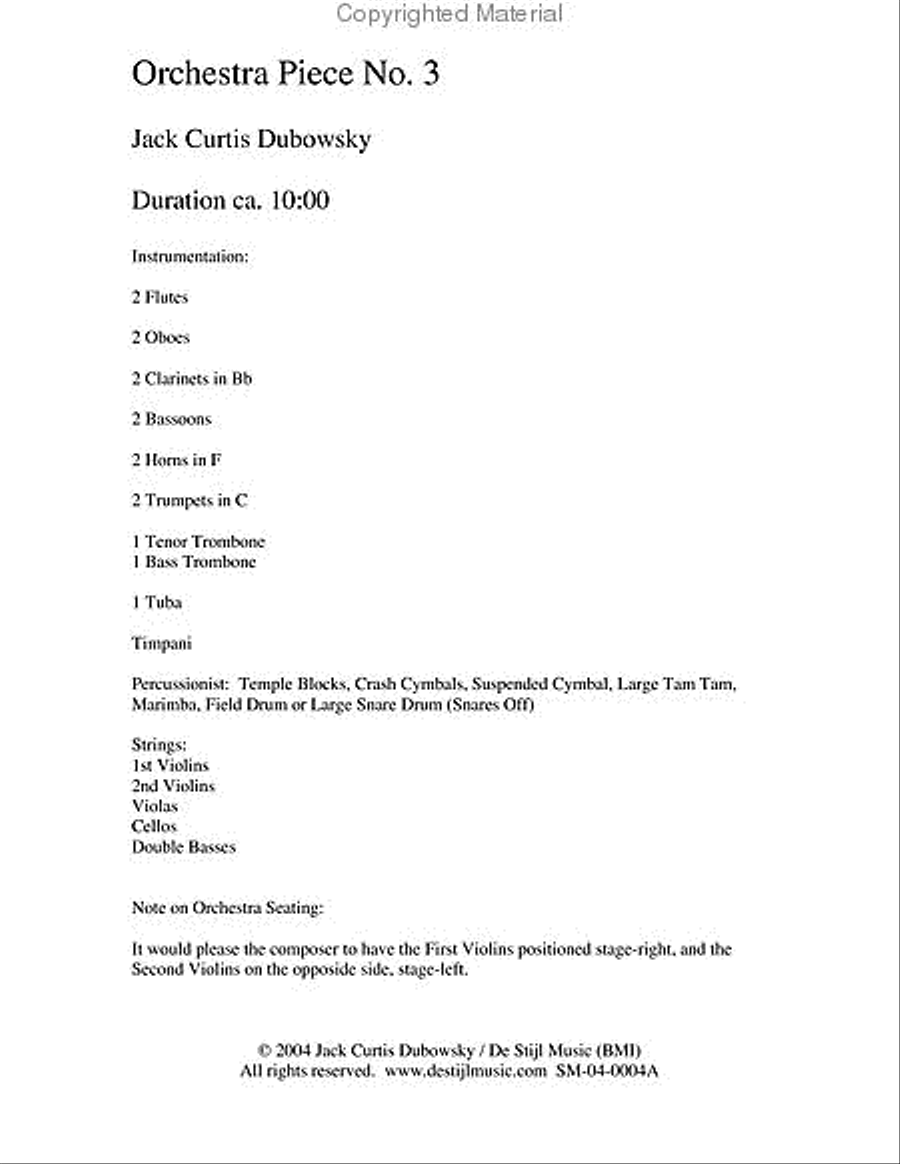
Composed by Jack Curtis Dubowsky. Orchestra. Contemporary. Full score. Composed 2004. Duration 10:00. De Stijl Music #SM-04-0004A. Published by De Stijl Music (D1.SM-04-0004A).
11 x 17 inches.
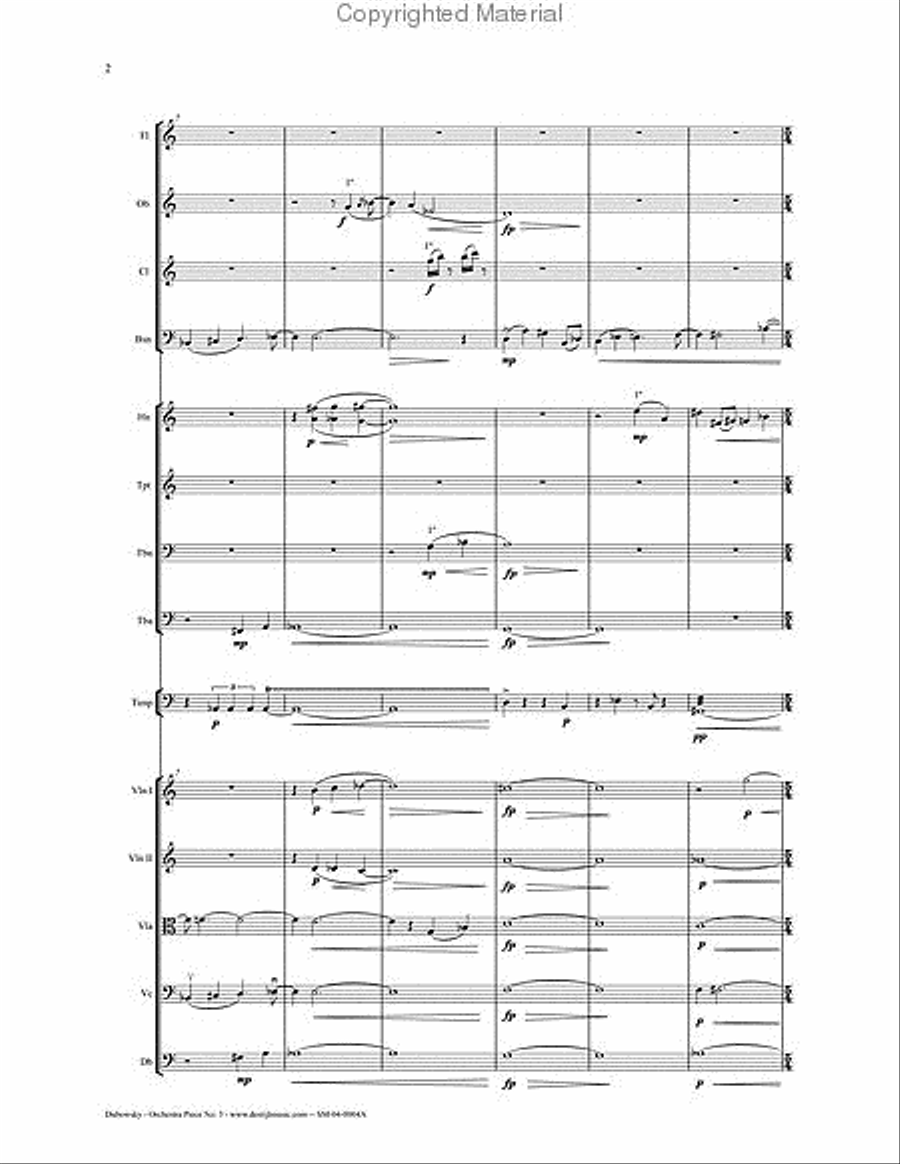
I initially composed Orchestra Piece No.3 over a period of eight months, from June 2002 to January 2003, in New York City. I have revised it substantially since then. I endeavored to create a piece with tremendous unity in a contemporary vocabulary, which would be solid and recognizable to an audience. I wanted one movement in one marked tempo, which a conductor could push and pull at will, following the energy of the music itself. Orchestra Piece No.3 begins with an 11-note motive introduced in the violins. All subsequent material in the piece is spun from that 11-note motive. The signature chords which reoccur throughout the piece (first in measure 8; a major 6th interval exploding chromatically to major 7th then to minor 9th) are based on the chromatic rise in the motive. These chords are filled out in the final climax by the superimposition of other fragments of the motive (see especially mm 177-180). Certain sections of the piece (mm 62-68 and mm 89-96 for instance) were created by recording and notating free improvisations that follow patterns already established in the piece. The piece ends in a rousing tutti, a tonal harmonization of the motive in the manner of a fanfare (mm 156-172), with quite a few bright open fifths. The marked tempo of "Andante sostenuto" quarter=76 allows for both slow sections and an allegro eighth note=152, giving the feeling of doubletime, in this section as well as in the section mm 38-57.
Composed by Jack Curtis Dubowsky. Orchestra. Contemporary. Full score. Composed 2004. Duration 10:00. De Stijl Music #SM-04-0004A. Published by De Stijl Music (D1.SM-04-0004A).
11 x 17 inches.
I initially composed Orchestra Piece No.3 over a period of eight months, from June 2002 to January 2003, in New York City. I have revised it substantially since then. I endeavored to create a piece with tremendous unity in a contemporary vocabulary, which would be solid and recognizable to an audience. I wanted one movement in one marked tempo, which a conductor could push and pull at will, following the energy of the music itself. Orchestra Piece No.3 begins with an 11-note motive introduced in the violins. All subsequent material in the piece is spun from that 11-note motive. The signature chords which reoccur throughout the piece (first in measure 8; a major 6th interval exploding chromatically to major 7th then to minor 9th) are based on the chromatic rise in the motive. These chords are filled out in the final climax by the superimposition of other fragments of the motive (see especially mm 177-180). Certain sections of the piece (mm 62-68 and mm 89-96 for instance) were created by recording and notating free improvisations that follow patterns already established in the piece. The piece ends in a rousing tutti, a tonal harmonization of the motive in the manner of a fanfare (mm 156-172), with quite a few bright open fifths. The marked tempo of "Andante sostenuto" quarter=76 allows for both slow sections and an allegro eighth note=152, giving the feeling of doubletime, in this section as well as in the section mm 38-57.
Preview: Orchestra Piece No 3 Full Score
Tell A Friend
Tell a friend (or remind yourself) about this product. We'll instantly send an email containing product info and a link to it. You may also enter a personal message.
We do not use or store email addresses from this form for any other purpose than sending your share email.
After purchase, you can download your MP3 from your Sheet Music Plus Digital Library - no software installation is necessary! You can also listen to your MP3 at any time in your Digital Library.
Learn about Smart Music
After purchase, you can download your Smart Music from your Sheet Music Plus Digital Library - no software installation is necessary! You can also download at any time in your Digital Library.
Learn about Digital Video
After purchase you can download your video from your Digital Library. Your video is in XX format and is playable on most pre-installed video players.