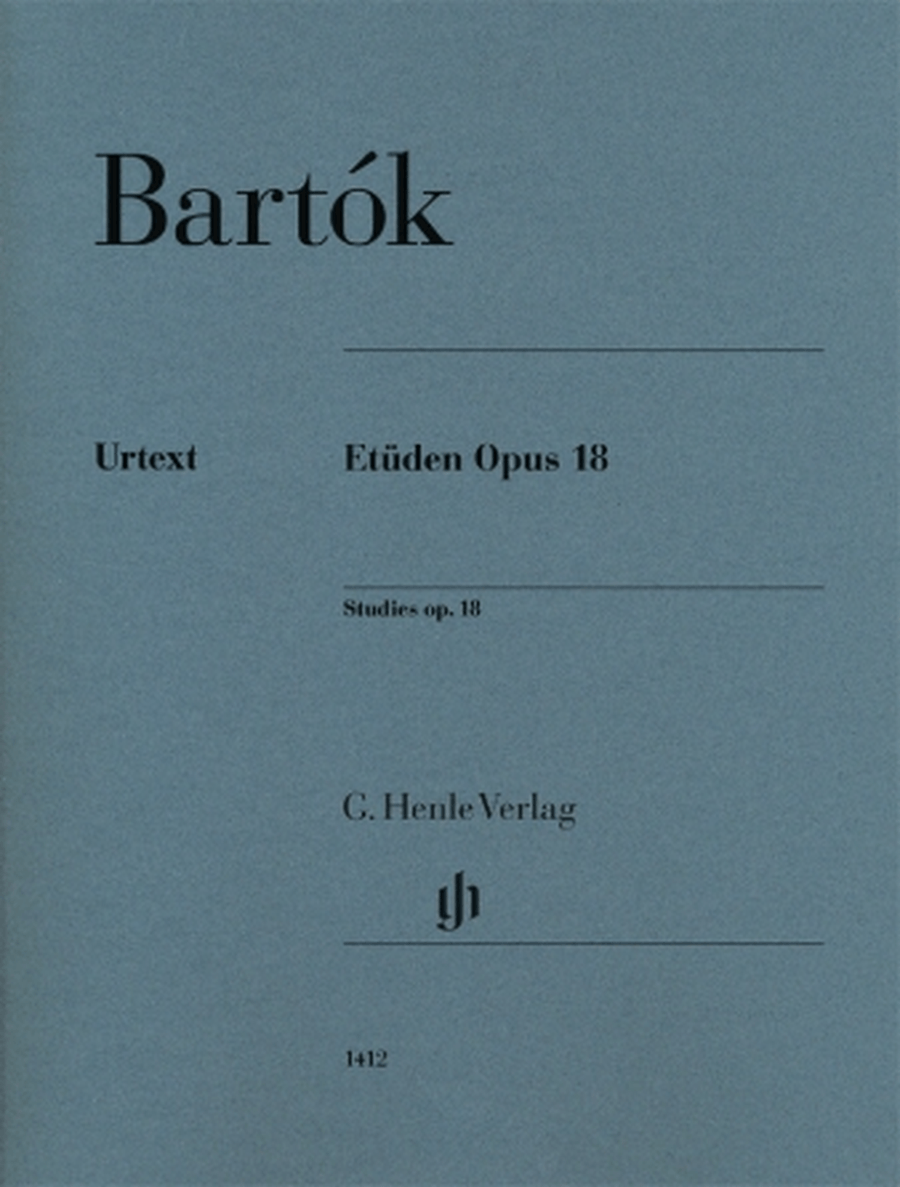
Etudes Op. 18 Piano Solo by Bela Bartok Piano Method - Sheet Music
By Bela BartokWith these three studies Bartók quite deliberately aimed to leave his mark on New Music in 1918. The first study is a kind of super-charged, motorically vehement Allegro barbaro, while the second, with its effervescent waterfalls of sound, seems redolent of an elegy inspired by Debussy. In the third, by contrast, Schönberg's influence is recognizable. The latter's “Private Musical Performances” in Vienna were also among the few occasions in the 1920s where Bartók's supremely demanding cycle - for performers and for listeners - was played multiple times. Published by Universal Edition in 1918, the initial printing of the first edition was sold out so quickly that a second was already issued in 1921. László Somfai's Urtext edition is based on the musical text of the Bartók Complete Edition and, in addition to an exciting preface on the origins of the piece, features interesting, practical suggestions for performance as well. Joint publishing venture with Editio Musica Budapest
Details
Summary
- Instrument:
- Piano Method Piano Solo
- Genres:
- 20th Century Hungarian
- Composers:
- Bela Bartok
- Publishers:
- G. Henle
- Series:
- Henle Urtext
- UPC:
- 840126932942
- Format:
- Collection / Songbook
- Item types:
- Physical
- Instructionals:
- Etudes and Exercises
- Musical forms:
- Etude
- Artist:
- Bela Bartok
- Usages:
- School and Community Sacred
- Number of Pages:
- 32
- Size:
- 9.0x12.0x0.129 inches
- Shipping Weight:
- 0.41 pounds
Detailed Description
SKU: HL.51481412
Piano Solo. Composed by Bela Bartok. Edited by Lá, Somfai, and szló. Henle Music Folios. Classical. Softcover. 32 pages. G. Henle #HN1412. Published by G. Henle (HL.51481412).UPC: 840126932942. 9.0x12.0x0.129 inches.
With these three studies Bartók quite deliberately aimed to leave his mark on New Music in 1918. The first study is a kind of super-charged, motorically vehement Allegro barbaro, while the second, with its effervescent waterfalls of sound, seems redolent of an elegy inspired by Debussy. In the third, by contrast, Schönberg's influence is recognizable. The latter's “Private Musical Performances” in Vienna were also among the few occasions in the 1920s where Bartók's supremely demanding cycle - for performers and for listeners - was played multiple times. Published by Universal Edition in 1918, the initial printing of the first edition was sold out so quickly that a second was already issued in 1921. László Somfai's Urtext edition is based on the musical text of the Bartók Complete Edition and, in addition to an exciting preface on the origins of the piece, features interesting, practical suggestions for performance as well. Joint publishing venture with Editio Musica Budapest.
About Henle Urtext
What I can expect from Henle Urtext editions:
- error-free, reliable musical texts based on meticulous musicological research - fingerings and bowings by famous artists and pedagogues
- preface in 3 languages with information on the genesis and history of the work
- Critical Commentary in 1 – 3 languages with a description and evaluation of the sources and explaining all source discrepancies and editorial decisions
- most beautiful music engraving
- page-turns, fold-out pages, and cues where you need them
- excellent print quality and binding
- largest Urtext catalogue world-wide
- longest Urtext experience (founded 1948 exclusively for "Urtext" editions)
Similar Sheet Music & Digital Downloads
- More by this Composer:
- Bela Bartok Bela Bartok Piano Accompaniment Bela Bartok Violin Bela Bartok Piano Solo
- Series:
- Henle Urtext
- Instrument:
- Piano and Keyboard Piano Piano Method Piano and Keyboard Piano Piano Solo
- Artists:
- Bela Bartok
- Publisher:
- G. Henle