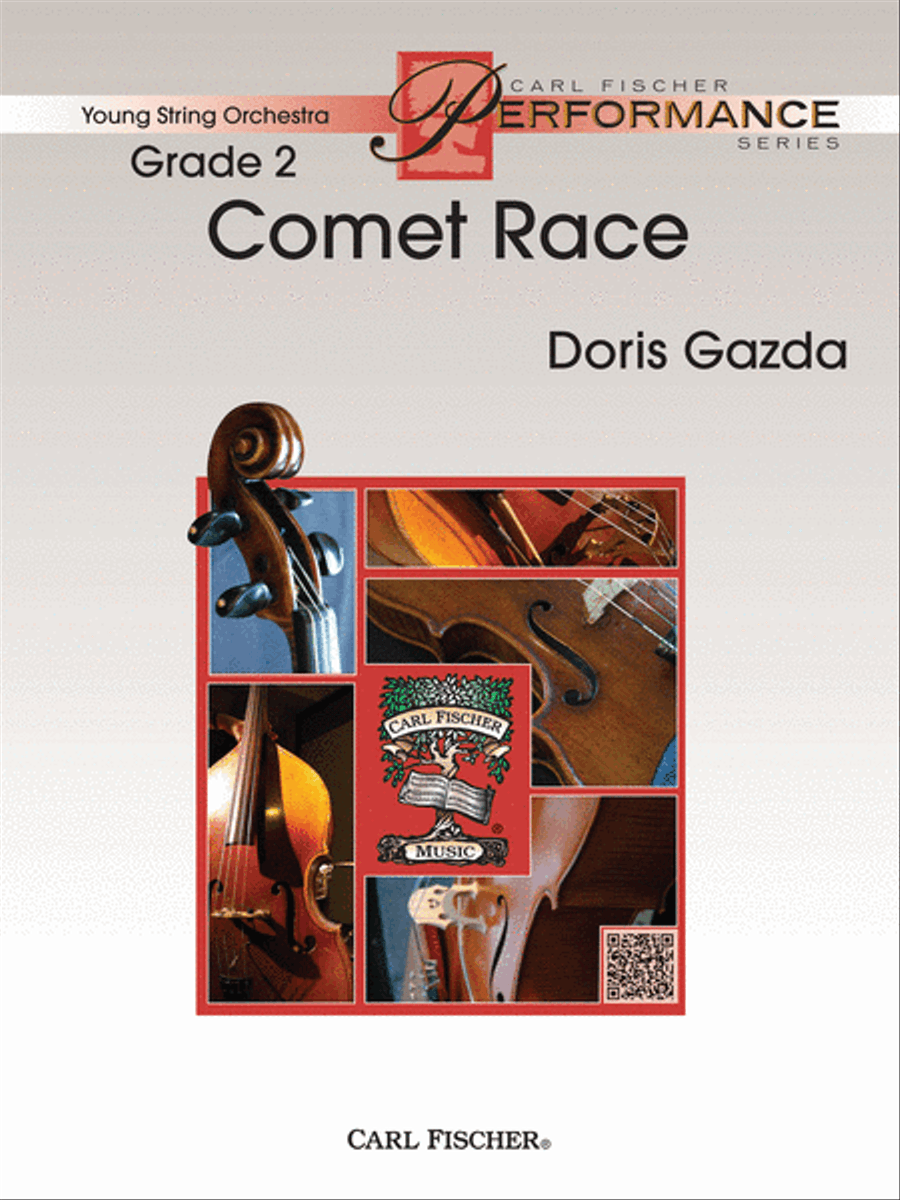
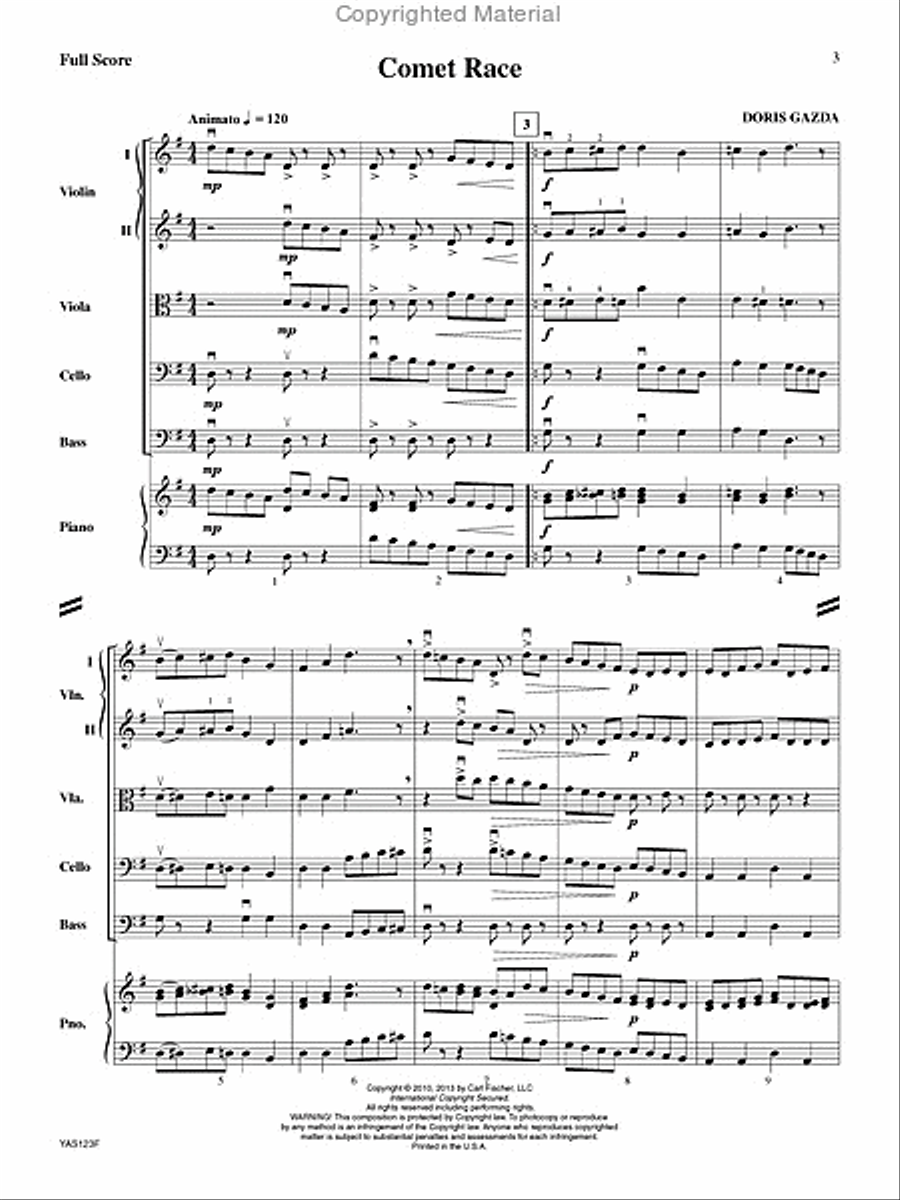
Comet Race by Doris Gazda String Orchestra - Sheet Music
By Doris GazdaComet Race paints a sonic picture of a comet and its tail racing across the sky on a dark night. Master string educator and composer Doris Gazda’s Comet Race will challenge your young students and delight your audience. This piece is a real gem and a welcome addition to the repertoire.If ever you are lucky enough to see a comet in the sky, you will notice that it is a bright orb encircled with a fuzzy atmosphere called a “coma” and a tail. It is composed of ice, dust and rocky particles. Comets orbit around the Sun. Both the coma and tail are illuminated by the Sun and may become visible from Earth when a comet passes through the inner solar system. The dust reflects sunlight directly and the gases glow from producing electrically charged atoms. This process is called ionization.Greek philosophers wrote about observing comets over 2,000 years ago. Possibly the mention of “falling stars” is actually an account of seeing a comet. Most comets are too faint to be visible without the aid of a telescope, but a few each decade become bright enough to be visible to the naked eye. Several of the great named comets are Halley's Comet, Comet Kohoutek and Comet Hale-Bopp. Astronomers can determine their orbit and predict when they will next appear.As a result of the gas surrounding the comets, they leave a trail of solid debris. If the comet’s path crosses Earth’s path, then at that point there are likely to be meteor showers as Earth passes through the trail of debris. The Perseid meteor shower, for example, occurs every year between August 9 and August 13, when Earth passes through the orbit of Comet Swift—Tuttle. Halley’s Comet is the source of the Orionid shower in October. Comet Race is my musical rendition of thinking about comets chasing each otheras they orbit through the Earth's atmosphere. It also depicts the calmness I experience when gazing at the stars and meteor showers. I do like to think of comets as being on a fast exciting ride through the solar system that we can see occasionally by gazing at the night sky.I hope that you will become star-gazers and enjoy some of the exciting nighttime events by watching the meteor showers and occasionally, a real comet!
Details
Summary
- Instrument:
- Cello Double Bass Piano Viola
- Ensembles:
- String Orchestra
- Genres:
- Classical
- Composers:
- Doris Gazda
- Publishers:
- Carl Fischer Music
- UPC:
- 798408091446
- ISBN:
- 9780825891441
- Format:
- Score Set of Parts Score and Parts
- Item types:
- Physical
- Level:
- Grade 2
- Artist:
- Doris Gazda
- Usages:
- School and Community
- Main Key:
- G major
- Number of Pages:
- 43
- Size:
- 9 x 12 inches
- Shipping Weight:
- 0.75 pounds
Detailed Description
SKU: CF.YAS123
Composed by Doris Gazda. Folio. Young String Orchestra. Score and parts. With Standard notation. 43 pages. Duration 0:03:13. Carl Fischer Music #YAS123. Published by Carl Fischer Music (CF.YAS123).ISBN 9780825891441. UPC: 798408091446. 9 x 12 inches. Key: G major.
Comet Race paints a sonic picture of a comet and its tail racing across the sky on a dark night. Master string educator and composer Doris Gazda’s Comet Race will challenge your young students and delight your audience. This piece is a real gem and a welcome addition to the repertoire.
If ever you are lucky enough to see a comet in the sky, you will notice that it is a bright orb encircled with a fuzzy atmosphere called a “coma” and a tail. It is composed of ice, dust and rocky particles. Comets orbit around the Sun. Both the coma and tail are illuminated by the Sun and may become visible from Earth when a comet passes through the inner solar system. The dust reflects sunlight directly and the gases glow from producing electrically charged atoms. This process is called ionization.Greek philosophers wrote about observing comets over 2,000 years ago. Possibly the mention of “falling stars” is actually an account of seeing a comet. Most comets are too faint to be visible without the aid of a telescope, but a few each decade become bright enough to be visible to the naked eye. Several of the great named comets are Halley's Comet, Comet Kohoutek and Comet Hale-Bopp. Astronomers can determine their orbit and predict when they will next appear.As a result of the gas surrounding the comets, they leave a trail of solid debris. If the comet’s path crosses Earth’s path, then at that point there are likely to be meteor showers as Earth passes through the trail of debris. The Perseid meteor shower, for example, occurs every year between August 9 and August 13, when Earth passes through the orbit of Comet Swift—Tuttle. Halley’s Comet is the source of the Orionid shower in October. Comet Race is my musical rendition of thinking about comets chasing each otheras they orbit through the Earth's atmosphere. It also depicts the calmness I experience when gazing at the stars and meteor showers. I do like to think of comets as being on a fast exciting ride through the solar system that we can see occasionally by gazing at the night sky.I hope that you will become star-gazers and enjoy some of the exciting nighttime events by watching the meteor showers and occasionally, a real comet!
Similar Sheet Music & Digital Downloads
- More by this Composer:
- Doris Gazda Doris Gazda Cello Doris Gazda Double Bass Doris Gazda Piano
- Instrument:
- Strings Cello Strings Double Bass Piano and Keyboard Piano Strings Viola
- Artists:
- Doris Gazda
- Ensemble:
- String Orchestra
- Publisher:
- Carl Fischer Music