Two Psalm Settings by Franz Schubert String Quartet - Digital Sheet Music
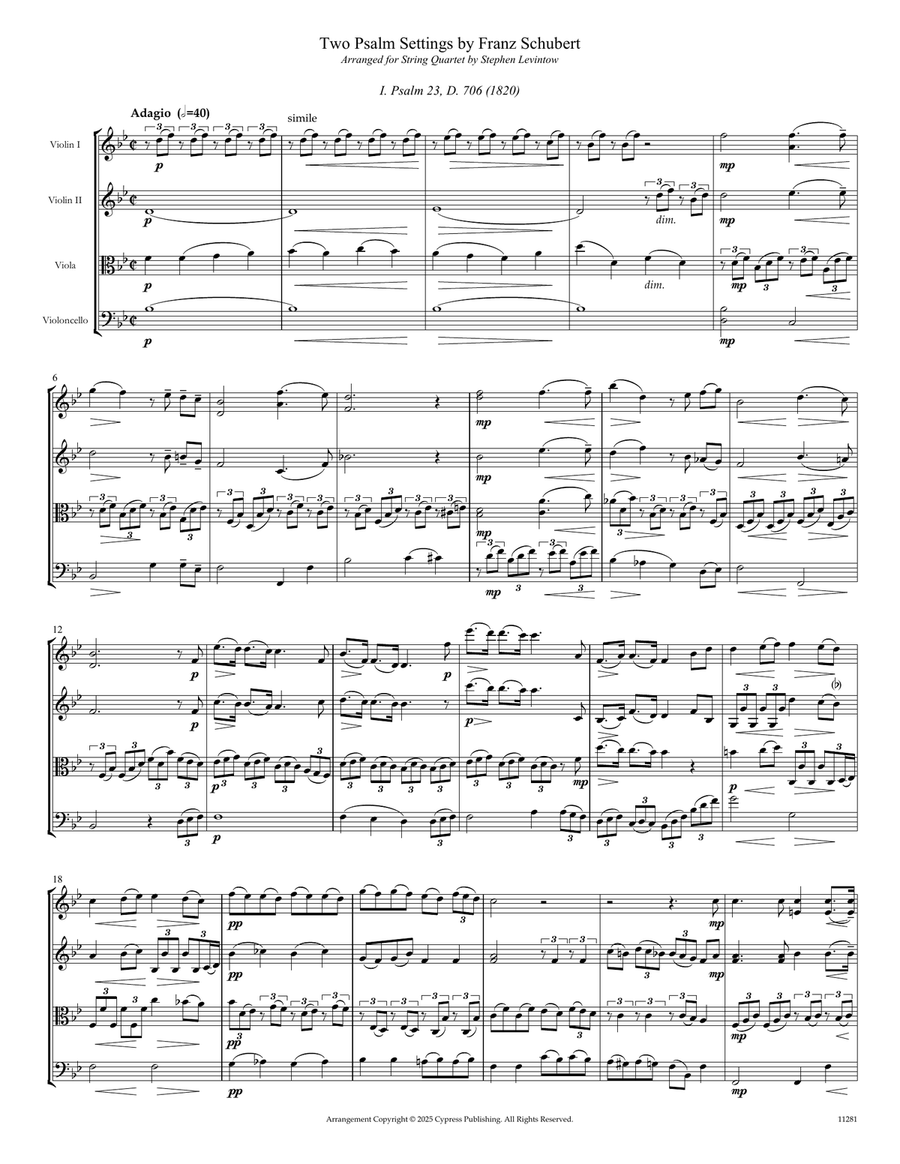
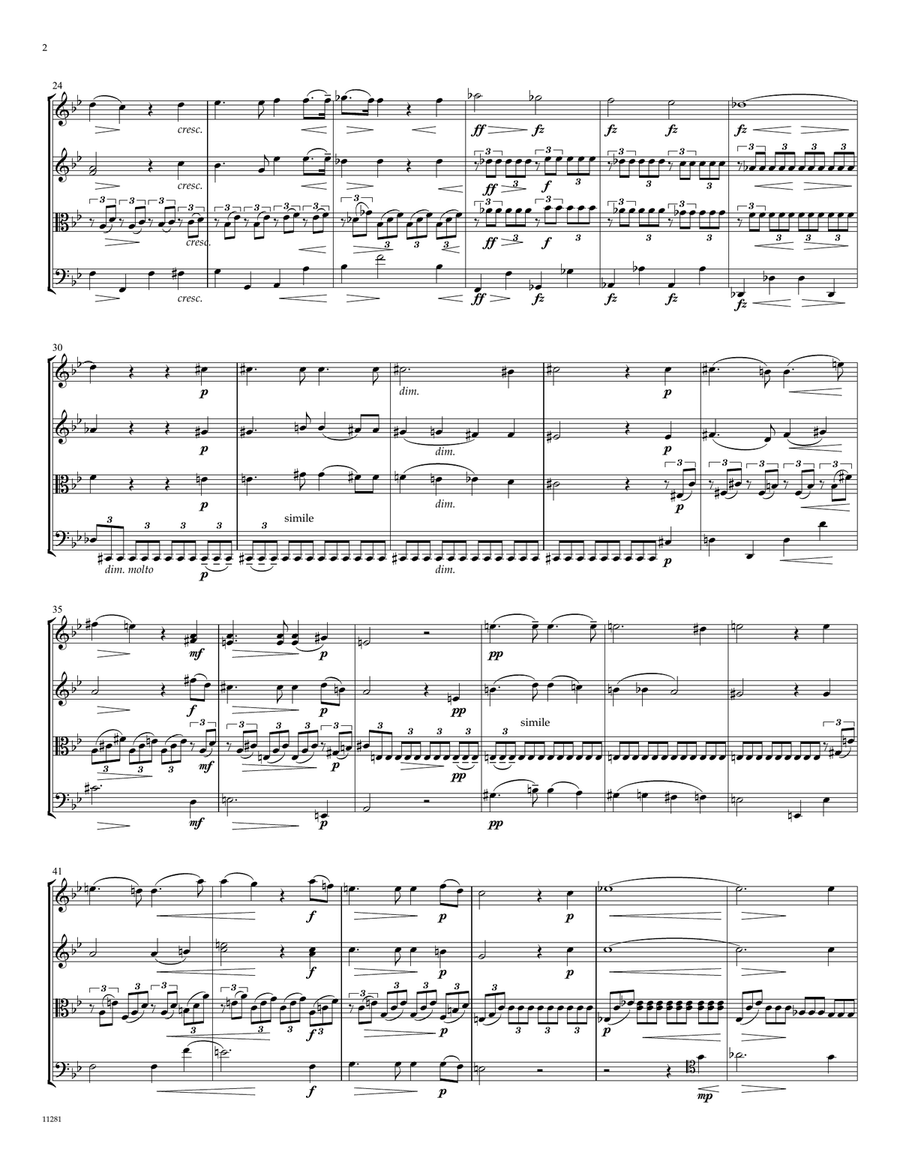
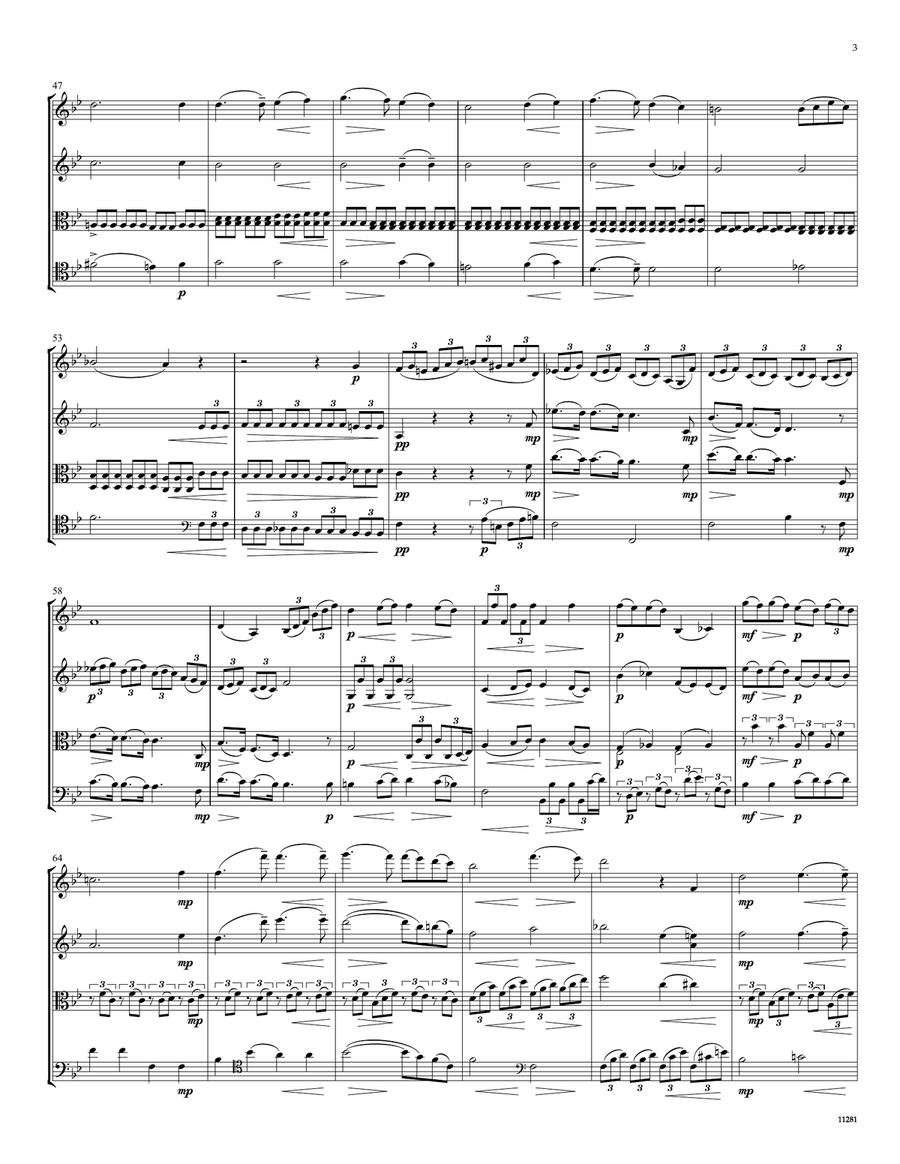
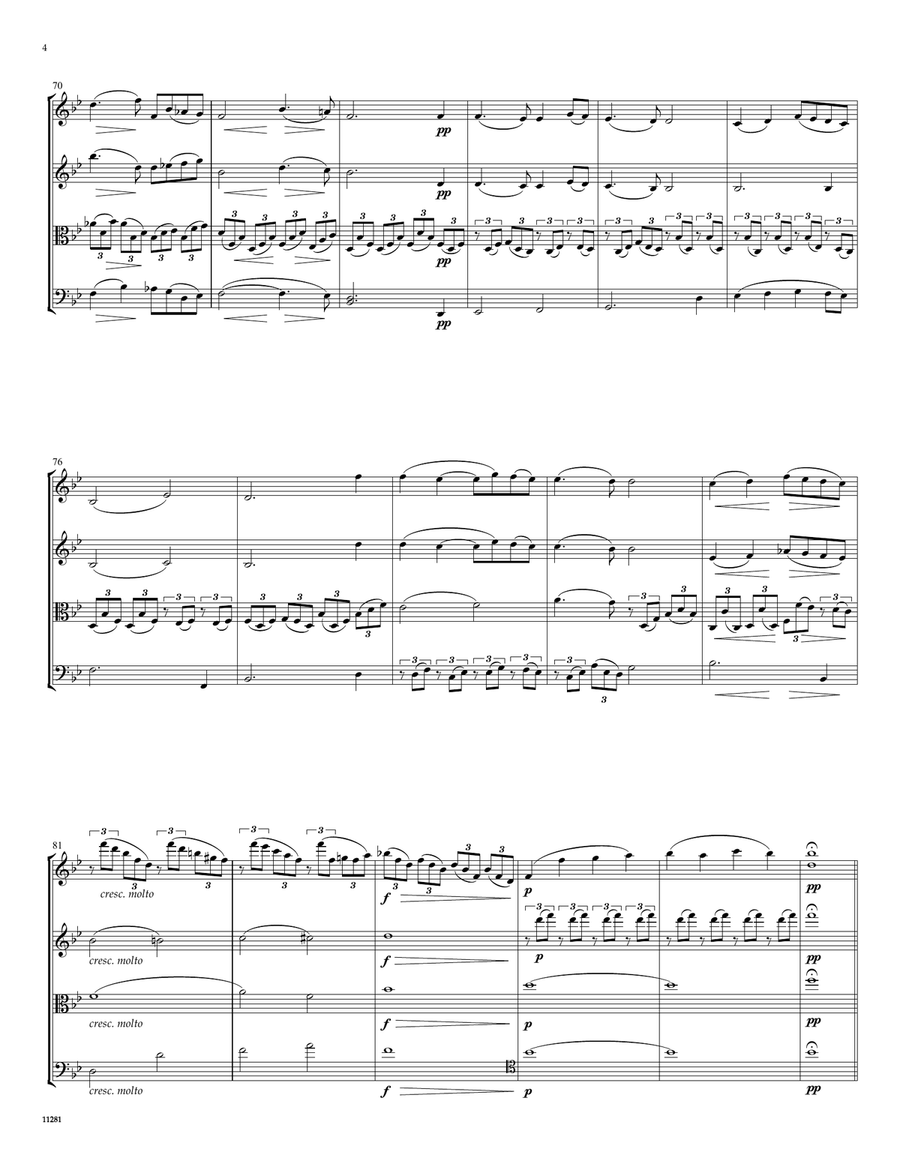
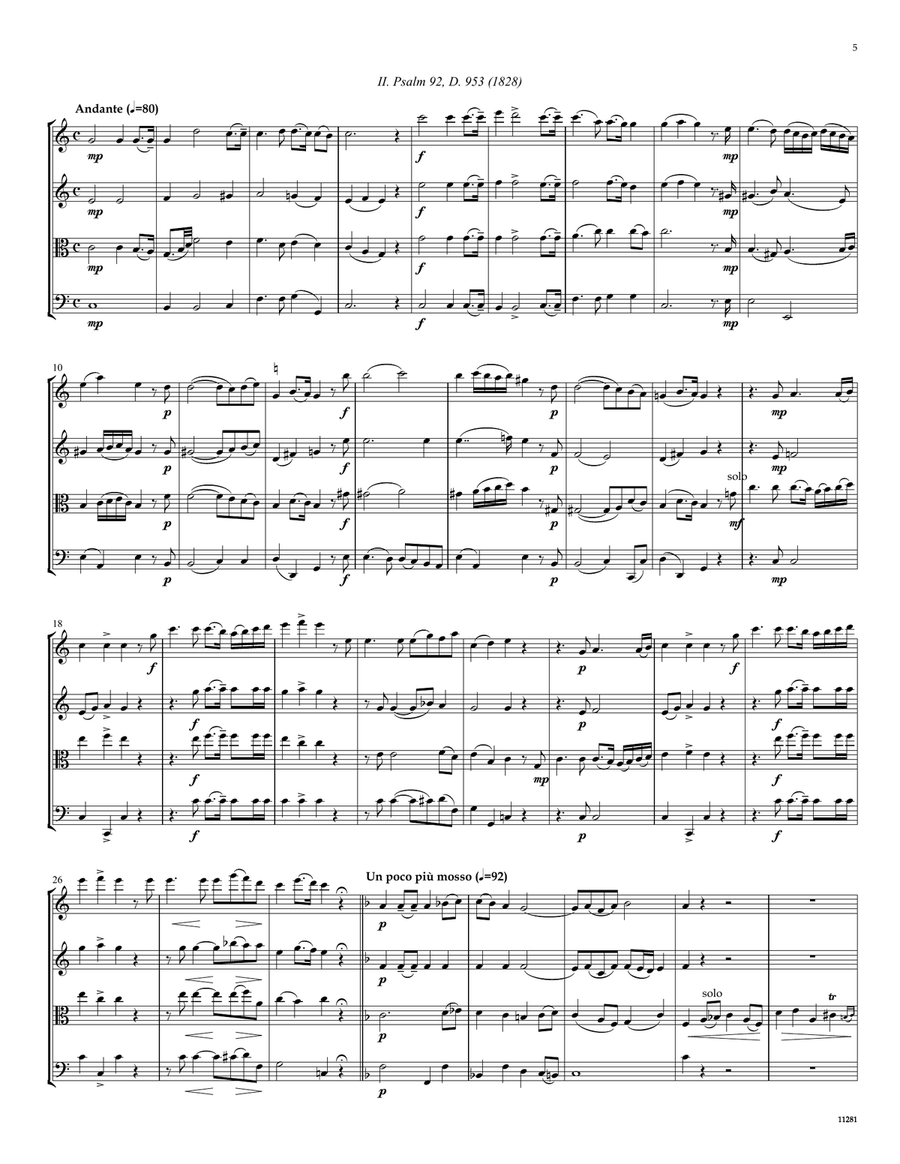
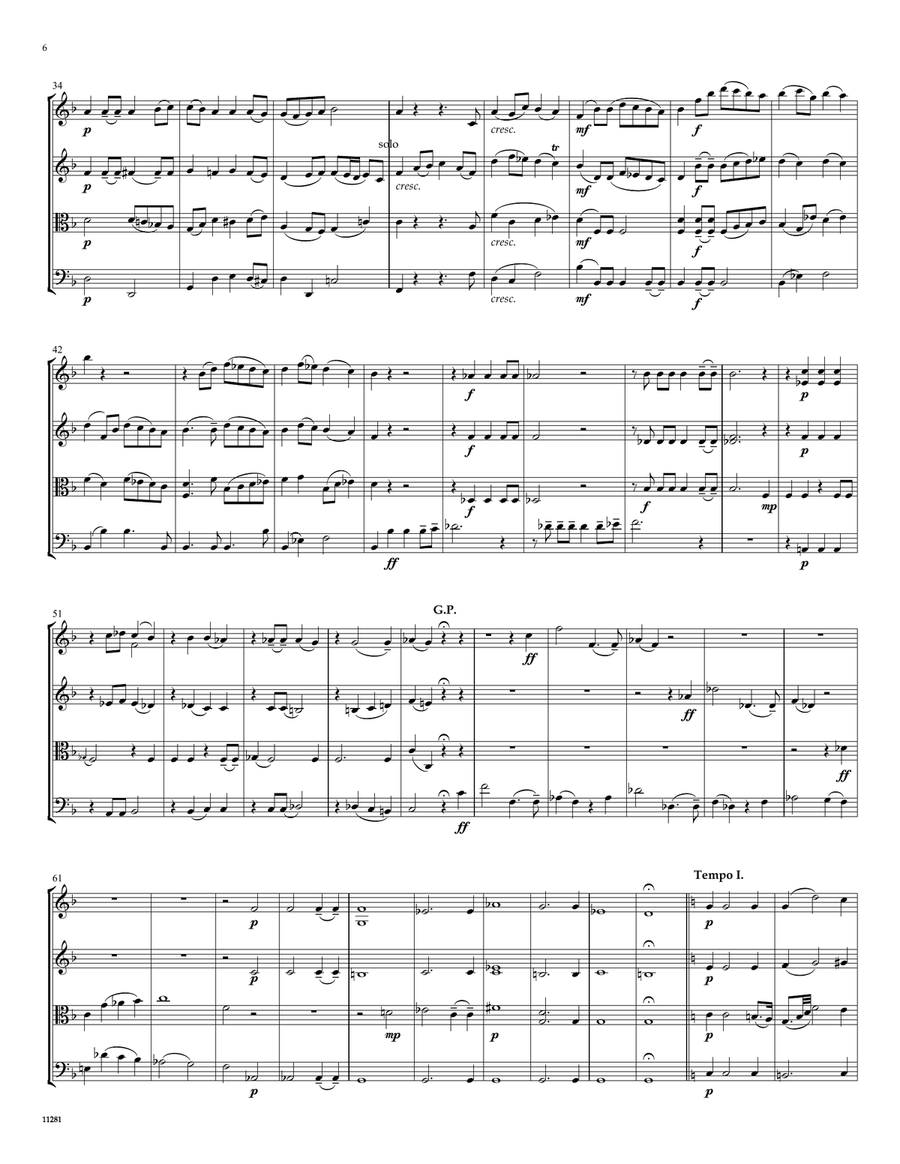
During Franz Schubert’s lifetime, his best-known and most frequently performed works were his part songs, short compositions for vocal ensemble, normally in four voices, either male, female, or mixed, with or without piano accompaniment. Though not as well known today, they are varied and imaginative, and some are small masterpieces. Schubert set both sacred and secular texts as part songs (as well as devotional poems that blur the difference). This arrangement for string quartet pairs two of his three settings of psalms from the Old Testament. Both are gentle and melodious, and include striking modulations to remote keys that feature in so many works of Schubert. Psalm 23 (“Gott ist mein Hirt” “The Lord is my shepherd”), perhaps the best known of all psalms, was a setting for four women’s voices and piano of the standard German translation by the scholar Moses Mendelssohn (grandfather of composer Felix Mendelssohn). The serene flowing melody of the voices is supported by running triplets on the piano, here distributed among the instruments in the quartet. The arrangement is transposed from the original A-Flat major to B-Flat for ease of playing. Psalm 92 dates from 1828, part of the astonishing productivity in the last year of his short life. While not comparable in scale to the multiple masterpieces of that year, it is nonetheless a remarkable achievement. It was written for the Reform Jewish congregation in Vienna, possibly as a commission, and Schubert set it in the original Hebrew, which he would have had to study in order to set the text properly. The setting is a cappella in four parts for mixed voices, with a baritone solo in the middle (also split among the instruments in the quartet arrangement) for the temple’s celebrated cantor Salomon Sulzer, who probably helped Schubert with the Hebrew text. The musical setting is quite simple, almost entirely homophonic except for a few canonic entries. Schubert made no effort to write music that sounds “Jewish”. For example, the melodic lines never employ the augmented second characteristic of Jewish liturgical singing (and other music of Middle Eastern origin). His clients likely preferred it that way, as one goal of the Reform movement of the time was to of modernize the musical service. The work ends with a twice-repeated plagal (“Amen”) cadence on the word l’olom (“forever”) – very much a Christian musical gesture! CYPRESS PUBLISHING is pleased to be the imprint for arrangements for string ensemble by Stephen Levintow. He is a free lance professional violist and violinist specializing in chamber music, who began making string quartet and trio arrangements for wedding, party and corporate events, to expand the repertory or to improve on existing versions. Selections include unusual pieces by both familiar and lesser-known composers, plus standard classical and popular favorites.The goal is to produce high-quality, musically satisfying arrangements faithful to the composer’s original material, yet sight-readable in most cases by working professionals or intermediate to advanced students. The full range of normal string technique is employed, while avoiding unnecessary technical complexity. Melodic material is distributed throughout the four voices where appropriate, to maintain listener and performer interest. All parts and scores are set in Sibelius© software format, with careful attention to legibility and page turns.
Details
Summary
- Ensembles:
- String Quartet
- Genres:
- Romantic Period Jewish
- Publishers:
- Cypress Publishing
- Series:
- ArrangeMe
Detailed Description
SKU: A0.1625497
Composed by Franz Schubert (1797-1828). Arranged by Stephen Levintow. This edition: pdf. 19th Century, Jewish, Religious, Romantic Period, Sacred. 16 pages. Cypress Publishing #1193961. Published by Cypress Publishing (A0.1625497).During Franz Schubert’s lifetime, his best-known and most frequently performed works were his part songs, short compositions for vocal ensemble, normally in four voices, either male, female, or mixed, with or without piano accompaniment. Though not as well known today, they are varied and imaginative, and some are small masterpieces.
Schubert set both sacred and secular texts as part songs (as well as devotional poems that blur the difference). This arrangement for string quartet pairs two of his three settings of psalms from the Old Testament. Both are gentle and melodious, and include striking modulations to remote keys that feature in so many works of Schubert.
Psalm 23 (“Gott ist mein Hirt” “The Lord is my shepherd”), perhaps the best known of all psalms, was a setting for four women’s voices and piano of the standard German translation by the scholar Moses Mendelssohn (grandfather of composer Felix Mendelssohn). The serene flowing melody of the voices is supported by running triplets on the piano, here distributed among the instruments in the quartet. The arrangement is transposed from the original A-Flat major to B-Flat for ease of playing.
Psalm 92 dates from 1828, part of the astonishing productivity in the last year of his short life. While not comparable in scale to the multiple masterpieces of that year, it is nonetheless a remarkable achievement. It was written for the Reform Jewish congregation in Vienna, possibly as a commission, and Schubert set it in the original Hebrew, which he would have had to study in order to set the text properly. The setting is a cappella in four parts for mixed voices, with a baritone solo in the middle (also split among the instruments in the quartet arrangement) for the temple’s celebrated cantor Salomon Sulzer, who probably helped Schubert with the Hebrew text.
The musical setting is quite simple, almost entirely homophonic except for a few canonic entries. Schubert made no effort to write music that sounds “Jewish”. For example, the melodic lines never employ the augmented second characteristic of Jewish liturgical singing (and other music of Middle Eastern origin). His clients likely preferred it that way, as one goal of the Reform movement of the time was to of modernize the musical service. The work ends with a twice-repeated plagal (“Amen”) cadence on the word l’olom (“forever”) – very much a Christian musical gesture!
CYPRESS PUBLISHING is pleased to be the imprint for arrangements for string ensemble by Stephen Levintow. He is a free lance professional violist and violinist specializing in chamber music, who began making string quartet and trio arrangements for wedding, party and corporate events, to expand the repertory or to improve on existing versions. Selections include unusual pieces by both familiar and lesser-known composers, plus standard classical and popular favorites.
The goal is to produce high-quality, musically satisfying arrangements faithful to the composer’s original material, yet sight-readable in most cases by working professionals or intermediate to advanced students. The full range of normal string technique is employed, while avoiding unnecessary technical complexity. Melodic material is distributed throughout the four voices where appropriate, to maintain listener and performer interest. All parts and scores are set in Sibelius© software format, with careful attention to legibility and page turns.
About ArrangeMe
This product was created by a member of ArrangeMe, Hal Leonard's self-publishing community for independent composers, arrangers, and songwriters. Discover unique arrangements of popular titles and original compositions from diverse creators. The length, difficulty, and pricing are determined by the arranger or composer.
About Digital Downloads
Digital Downloads let you instantly access sheet music on your computer, tablet, or mobile device. Print your sheet music anywhere, anytime, or play it straight from your device—no internet connection is required after download.
Each Digital Download includes a watermark with your name, purchase date, and the number of copies purchased. You may only print or use the number of copies purchased. Redistribution or unauthorized printing is prohibited.
Similar Sheet Music & Digital Downloads
- ArrangeMe:
- Cypress Publishing
- Series:
- ArrangeMe
- Ensemble:
- String Quartet
- Publisher:
- Cypress Publishing