Ludus Tonalis (1942) Studies in Counterpoint, Tonal Organization and Piano Playing by Paul Hindemith Piano Accompaniment - Sheet Music
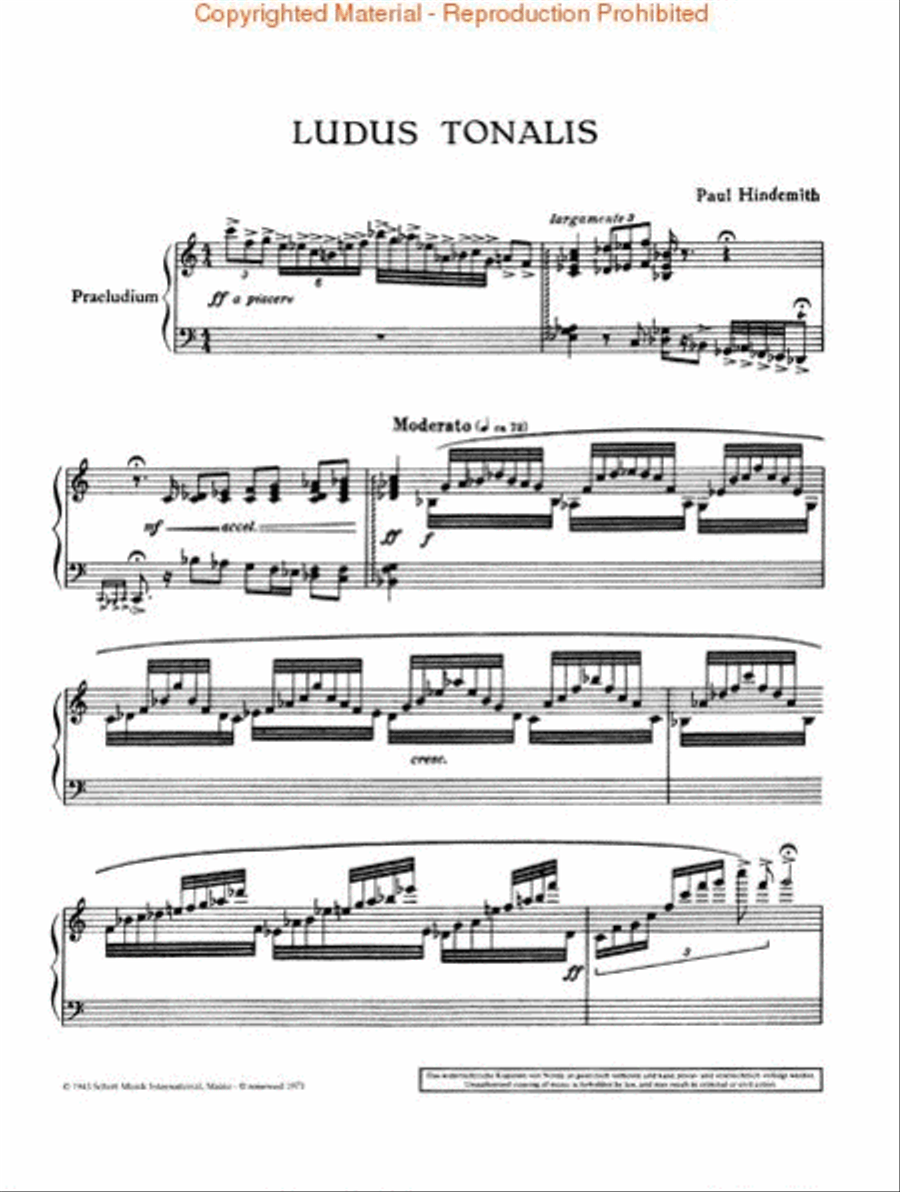
By Paul HindemithThe cycle of fugues is introduced and concluded by a Praeludium and Postludium, the second formed by turning the Praeludium upside down and reading it backwards. In solving technical problems he posed himself, Hindemith created a work of considerable imagination. Intellectual achievement and sheer delight in playing are shown not to be mutually exclusive. The Ludus is a graphic example of the composer's delight in the fantastic. He illustrated the work with colored pencil, drawing a lion for each entry of the subject of the fugues. And for each of the twelve, a different kind of lion according to the character of the music, providing an instructive formal analysis of the music.
Details
Summary
- Instrument:
- Piano Accompaniment Piano Solo
- Genres:
- 20th Century Contemporary
- Composers:
- Paul Hindemith
- Publishers:
- Schott Music
- UPC:
- 073999979305
- ISBN:
- 9783795795627
- Item types:
- Physical
- Instructionals:
- Etudes and Exercises
- Level:
- Advanced
- Artist:
- Paul Hindemith
- Usages:
- Sacred
- Number of Pages:
- 62
- Size:
- 9.25x12.0x0.252 inches
- Shipping Weight:
- 0.74 pounds
Detailed Description
SKU: HL.49004546
Studies in Counterpoint, Tonal Organization and Piano Playing. Composed by Paul Hindemith. This edition: Saddle stitching. Sheet music. Edition Schott. Classical, Contemporary. Composed 1942. 62 pages. Duration 60'. Schott Music #ED3964. Published by Schott Music (HL.49004546).ISBN 9783795795627. UPC: 073999979305. 9.25x12.0x0.252 inches.
The cycle of fugues is introduced and concluded by a Praeludium and Postludium, the second formed by turning the Praeludium upside down and reading it backwards. In solving technical problems he posed himself, Hindemith created a work of considerable imagination. Intellectual achievement and sheer delight in playing are shown not to be mutually exclusive. The Ludus is a graphic example of the composer's delight in the fantastic. He illustrated the work with colored pencil, drawing a lion for each entry of the subject of the fugues. And for each of the twelve, a different kind of lion according to the character of the music, providing an instructive formal analysis of the music.
Similar Sheet Music & Digital Downloads
- More by this Composer:
- Paul Hindemith Paul Hindemith Cello Paul Hindemith Piano Accompaniment Paul Hindemith Violin
- Artists:
- Paul Hindemith
- Publisher:
- Schott Music
Ratings + Reviews
4 Rating
2 reviews
James E.
Mar 2, 2012
Most of the liner notes and newspaper reviews focus on Hindemiths harmonic theory, which is embodied in the sequences of fugues, and on the pieces technical accomplishments. It is an extended response to Bach's WTC. (See Gabriela Vlahopols essay Baroque Reflections in Ludus Tonalis by Paul Hindemith, available on the internet.) But Hindemith was very interested in the pleasure of playing, and almost all of this is easy to learn. It's also a textbook of the fugue. It is often inexpressive and dry, but that is part of Hindemith's mode.
Vicki
Dec 10, 2011
This appears to be the only publication available for Ludus Tonalis. I have yet to begin teaching with it but the presentation appears to be clear and easy to read.