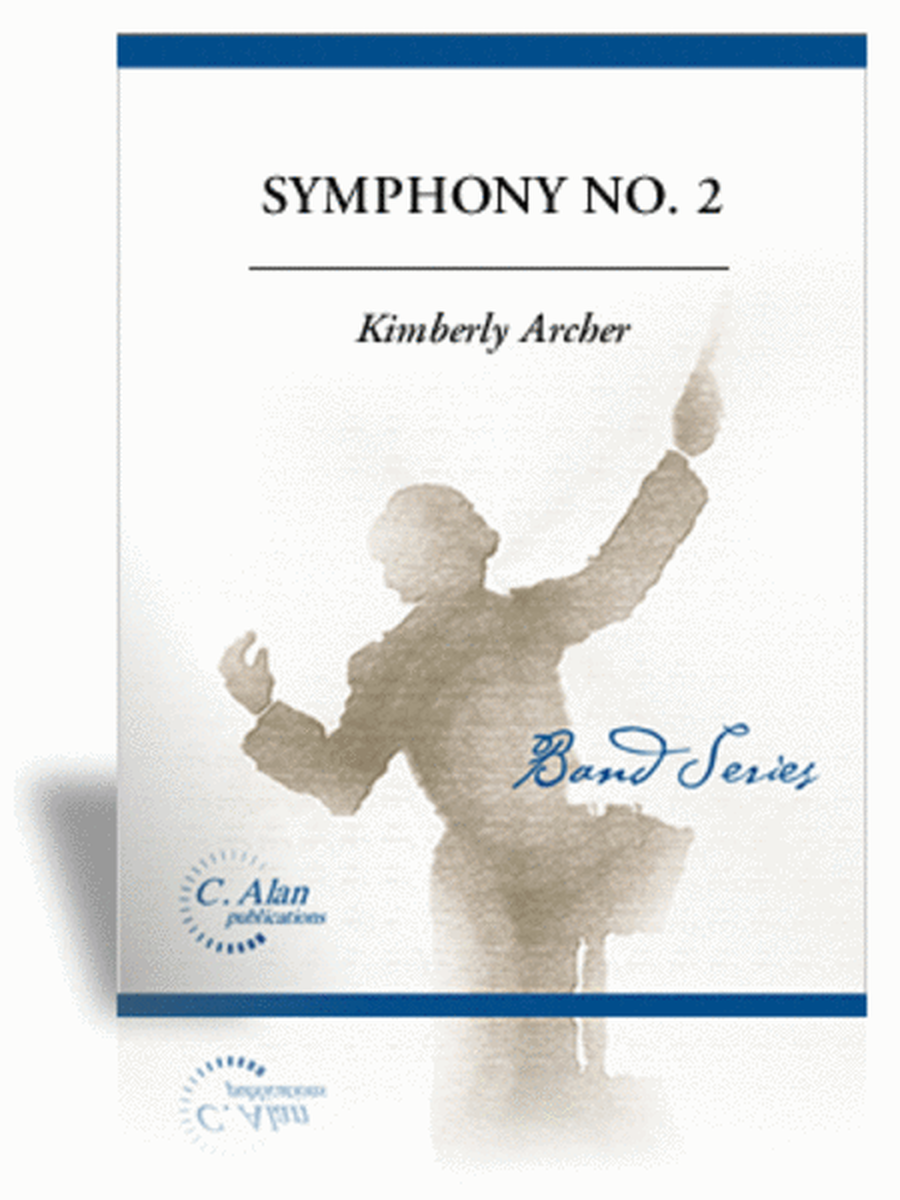
Symphony No. 2 by Kimberly Archer Concert Band - Sheet Music
By Kimberly ArcherSetting off with playful and humorous March with a bit of Scherzo mixed in, you next tumble into a modern movement in the style of Philip Glass. Listen for allusions to Star Trek in this section! The third and final movement is an eclectic work based on the hymn "Blessed Assurance".Symphony No. 2 is my doctoral dissertation. At this significant point in my life and career, I feel it is important to pay homage to three people who have been critical in my getting this far, both personally and professionally. I. March is dedicated to Andy Waggoner, my first composition teacher in graduate school. By form it is a march, but by style, a scherzo. It is intended to be playful and humorous (reflective of our personal relationship), but also makes use of several of the concepts and skills he taught me, including how to use octatonic collections. II. Passacaglia is dedicated to Pat Dunnigan. Pat taught me to use Finale, premiered several of my early band compositions (including my first symphony), and has been my friend and mentor for more than ten years. His movement is composed in the style of Phillip Glass - one of his favorite composers. There are also allusions to the 'Star Trek' theme and Mahler's Symphony No. 1. III. Theme and Variations is dedicated to my father, who is a former church organist, and particularly fond of the hymn 'Blessed Assurance.' All three movements of the symphony include elements of this hymn in some form, thus adding unity to an otherwise eclectic work, but the third movement takes the hymn as its outright theme. Some of my earliest musical experiences involved listening to my dad practice or having him accompany me for solos and auditions. I doubt I would have pursued music professionally, or have survived graduate school, had it not been for him. - Kim Archer Symphony No. 2 is conceived for a full symphonic band rather than a true wind ensemble, which assumes that at least all the flute and clarinet parts will be doubled. The piano part for Movements II and III and the string bass part for Movements I and II should both be clearly audible, particularly in solo passages. String bass should be positioned near the front of the stage and the piano should use full stick.
Details
Summary
- Ensembles:
- Concert Band
- Genres:
- Classical
- Composers:
- Kimberly Archer
- Publishers:
- C. Alan Publications
- Format:
- Score
- Item types:
- Physical
- Level:
- Grade 5
- Musical forms:
- Symphony
- Artist:
- Kimberly Archer
- Usages:
- School and Community
- Shipping Weight:
- 1.5 pounds
Detailed Description
SKU: CN.10181
Composed by Kimberly Archer. Band Music. Score only. Duration 21:00. Published by C. Alan Publications (CN.10181).Setting off with playful and humorous March with a bit of Scherzo mixed in, you next tumble into a modern movement in the style of Philip Glass. Listen for allusions to Star Trek in this section! The third and final movement is an eclectic work based on the hymn "Blessed Assurance".
Symphony No. 2 is my doctoral dissertation. At this significant point in my life and career, I feel it is important to pay homage to three people who have been critical in my getting this far, both personally and professionally. I. March is dedicated to Andy Waggoner, my first composition teacher in graduate school. By form it is a march, but by style, a scherzo. It is intended to be playful and humorous (reflective of our personal relationship), but also makes use of several of the concepts and skills he taught me, including how to use octatonic collections. II. Passacaglia is dedicated to Pat Dunnigan. Pat taught me to use Finale, premiered several of my early band compositions (including my first symphony), and has been my friend and mentor for more than ten years. His movement is composed in the style of Phillip Glass - one of his favorite composers. There are also allusions to the 'Star Trek' theme and Mahler's Symphony No. 1. III. Theme and Variations is dedicated to my father, who is a former church organist, and particularly fond of the hymn 'Blessed Assurance.' All three movements of the symphony include elements of this hymn in some form, thus adding unity to an otherwise eclectic work, but the third movement takes the hymn as its outright theme. Some of my earliest musical experiences involved listening to my dad practice or having him accompany me for solos and auditions. I doubt I would have pursued music professionally, or have survived graduate school, had it not been for him. - Kim Archer Symphony No. 2 is conceived for a full symphonic band rather than a true wind ensemble, which assumes that at least all the flute and clarinet parts will be doubled. The piano part for Movements II and III and the string bass part for Movements I and II should both be clearly audible, particularly in solo passages. String bass should be positioned near the front of the stage and the piano should use full stick.
Similar Sheet Music & Digital Downloads
- More by this Composer:
- Kimberly Archer Kimberly Archer Euphonium Kimberly Archer Piano Accompaniment Kimberly Archer Tuba
- Artists:
- Kimberly Archer
- Ensemble:
- Concert Band
- Publisher:
- C. Alan Publications