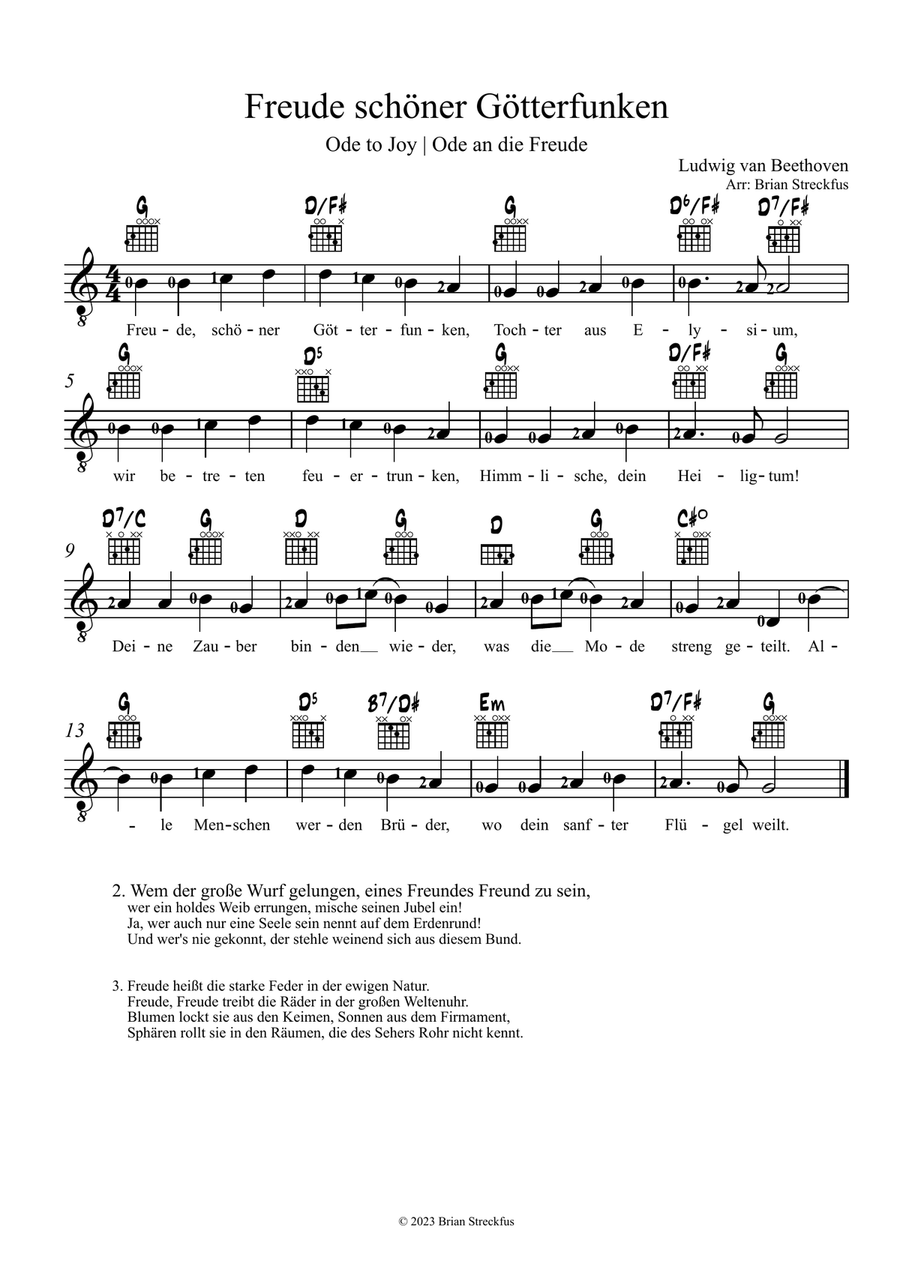
Ode to Joy (Freude schöner Götterfunken) by Ludwig van Beethoven Acoustic Guitar - Digital Sheet Music
By Ludwig van BeethovenDisclaimer:
Disclaimer: It may go without saying, but this is just an excerpt of the famous part of Beethoven's Ninth Symphony.Be careful when printing if you really want both pages, because they are roughly the same. I had a hard time deciding between more lyrics or larger chord charts. So rather than settling for one of the other, you get both for a low price. Just be careful of your printer settings!Features:1. Arranged for guitar2. Harmonized to be idiomatic for guitar and to take part writing into consideration (many other publications would just use cookie cutter chords)3. Fonts made larger and more appealing4. Guitar fingerings5. Engraved to make phrases obvious6. LyricsHistory:"Ode to Joy" is one of the most famous and recognizable pieces of music composed by Ludwig van Beethoven. Here are some key facts about it:1. **Symphony No. 9**: "Ode to Joy" is the final movement (fourth movement) of Beethoven's Symphony No. 9 in D minor, Op. 125, also known as the "Choral" Symphony.2. **Premiere**: Symphony No. 9 premiered on May 7, 1824, in Vienna. It was one of Beethoven's most significant and last major works, completed while he was almost completely deaf.3. **Text Source**: The lyrics of "Ode to Joy" are based on the poem "An die Freude" ("Ode to Joy") written by the German poet Friedrich Schiller in 1785. Beethoven slightly modified Schiller's text for his composition.4. **Universal Brotherhood**: The poem and the musical setting celebrate themes of universal brotherhood, unity, and joy. The famous line "Alle Menschen werden Brüder" ("All men shall become brothers") embodies these themes.5. **Instrumentation and Voices**: The movement features a full orchestra, four solo vocalists (soprano, alto, tenor, and bass), and a mixed choir. It was groundbreaking for its time as it was the first symphony by a major composer to include vocal soloists and a choir in a symphonic setting.6. **Melody**: The main melody of "Ode to Joy" is simple, uplifting, and highly memorable. It has become one of the most recognizable tunes in classical music and has been adapted in numerous ways across different musical genres and contexts.7. **European Anthem**: In 1972, the Council of Europe adopted Beethoven's "Ode to Joy" theme as the official European Anthem. Later, it was also adopted by the European Union.8. **Cultural Impact**: "Ode to Joy" has been used in various cultural, political, and social contexts. It has been performed at numerous significant events, including the fall of the Berlin Wall and the Olympic Games, symbolizing peace, freedom, and unity.9. **Arrangements and Adaptations**: The melody has been adapted into many different styles and arrangements, including popular music, jazz, rock, and even digital renditions. It has also been used in film scores, television shows, and advertisements."Ode to Joy" is the final movement of Beethoven's Ninth Symphony, completed in 1824. The text for this choral finale is based on a poem by Friedrich Schiller, celebrating unity and brotherhood. It was the first time a major composer used voices in a symphony, intergrating soloists and a choir with the orchestra. In 1972, the "Ode to Joy" theme was adopted as the anthem of the European Union.
Details
Summary
- Instrument:
- Acoustic Guitar Electric Guitar Classical Guitar
- Genres:
- Opera Classical Period Romantic Period Wedding
- Composers:
- Ludwig van Beethoven
- Publishers:
- Brian Streckfus
- Series:
- ArrangeMe
- Item types:
- Digital
- Level:
- Beginning
- Artist:
- Ludwig van Beethoven
- Usages:
- School and Community
- Number of Pages:
- 2
Detailed Description
SKU: A0.1272175
Composed by Ludwig van Beethoven. Arranged by Brian Streckfus. This edition: pdf. Classical, Opera, Romantic Period. Chords/Lyrics. 2 pages. Brian Streckfus #864492. Published by Brian Streckfus (A0.1272175).Disclaimer: It may go without saying, but this is just an excerpt of the famous part of Beethoven's Ninth Symphony.
Be careful when printing if you really want both pages, because they are roughly the same. I had a hard time deciding between more lyrics or larger chord charts. So rather than settling for one of the other, you get both for a low price. Just be careful of your printer settings!
Features:
1. Arranged for guitar
2. Harmonized to be idiomatic for guitar and to take part writing into consideration (many other publications would just use cookie cutter chords)
3. Fonts made larger and more appealing
4. Guitar fingerings
5. Engraved to make phrases obvious
6. Lyrics
History:
"Ode to Joy" is one of the most famous and recognizable pieces of music composed by Ludwig van Beethoven. Here are some key facts about it:
1. **Symphony No. 9**: "Ode to Joy" is the final movement (fourth movement) of Beethoven's Symphony No. 9 in D minor, Op. 125, also known as the "Choral" Symphony.
2. **Premiere**: Symphony No. 9 premiered on May 7, 1824, in Vienna. It was one of Beethoven's most significant and last major works, completed while he was almost completely deaf.
3. **Text Source**: The lyrics of "Ode to Joy" are based on the poem "An die Freude" ("Ode to Joy") written by the German poet Friedrich Schiller in 1785. Beethoven slightly modified Schiller's text for his composition.
4. **Universal Brotherhood**: The poem and the musical setting celebrate themes of universal brotherhood, unity, and joy. The famous line "Alle Menschen werden Brüder" ("All men shall become brothers") embodies these themes.
5. **Instrumentation and Voices**: The movement features a full orchestra, four solo vocalists (soprano, alto, tenor, and bass), and a mixed choir. It was groundbreaking for its time as it was the first symphony by a major composer to include vocal soloists and a choir in a symphonic setting.
6. **Melody**: The main melody of "Ode to Joy" is simple, uplifting, and highly memorable. It has become one of the most recognizable tunes in classical music and has been adapted in numerous ways across different musical genres and contexts.
7. **European Anthem**: In 1972, the Council of Europe adopted Beethoven's "Ode to Joy" theme as the official European Anthem. Later, it was also adopted by the European Union.
8. **Cultural Impact**: "Ode to Joy" has been used in various cultural, political, and social contexts. It has been performed at numerous significant events, including the fall of the Berlin Wall and the Olympic Games, symbolizing peace, freedom, and unity.
9. **Arrangements and Adaptations**: The melody has been adapted into many different styles and arrangements, including popular music, jazz, rock, and even digital renditions. It has also been used in film scores, television shows, and advertisements.
"Ode to Joy" is the final movement of Beethoven's Ninth Symphony, completed in 1824. The text for this choral finale is based on a poem by Friedrich Schiller, celebrating unity and brotherhood. It was the first time a major composer used voices in a symphony, intergrating soloists and a choir with the orchestra. In 1972, the "Ode to Joy" theme was adopted as the anthem of the European Union.
About ArrangeMe
This product was created by a member of ArrangeMe, Hal Leonard's self-publishing community for independent composers, arrangers, and songwriters. Discover unique arrangements of popular titles and original compositions from diverse creators. The length, difficulty, and pricing are determined by the arranger or composer.
About Digital Downloads
Digital Downloads let you instantly access sheet music on your computer, tablet, or mobile device. Print your sheet music anywhere, anytime, or play it straight from your device—no internet connection is required after download.
Each Digital Download includes a watermark with your name, purchase date, and the number of copies purchased. You may only print or use the number of copies purchased. Redistribution or unauthorized printing is prohibited.
Similar Sheet Music & Digital Downloads
- More by this Composer:
- Ludwig van Beethoven Ludwig van Beethoven Piano Ludwig van Beethoven Piano Accompaniment Ludwig van Beethoven Piano Solo
- ArrangeMe:
- Brian Streckfus
- Series:
- ArrangeMe
- Instrument:
- Guitar Acoustic Guitar Guitar Electric Guitar Guitar Classical Guitar
- Artists:
- Ludwig van Beethoven
- Publisher:
- Brian Streckfus