J.S. Bach: Six "Cello" Suites, arranged for solo saxophone by Paul Wehage by Johann Sebastian Bach Woodwind Quartet - Digital Sheet Music
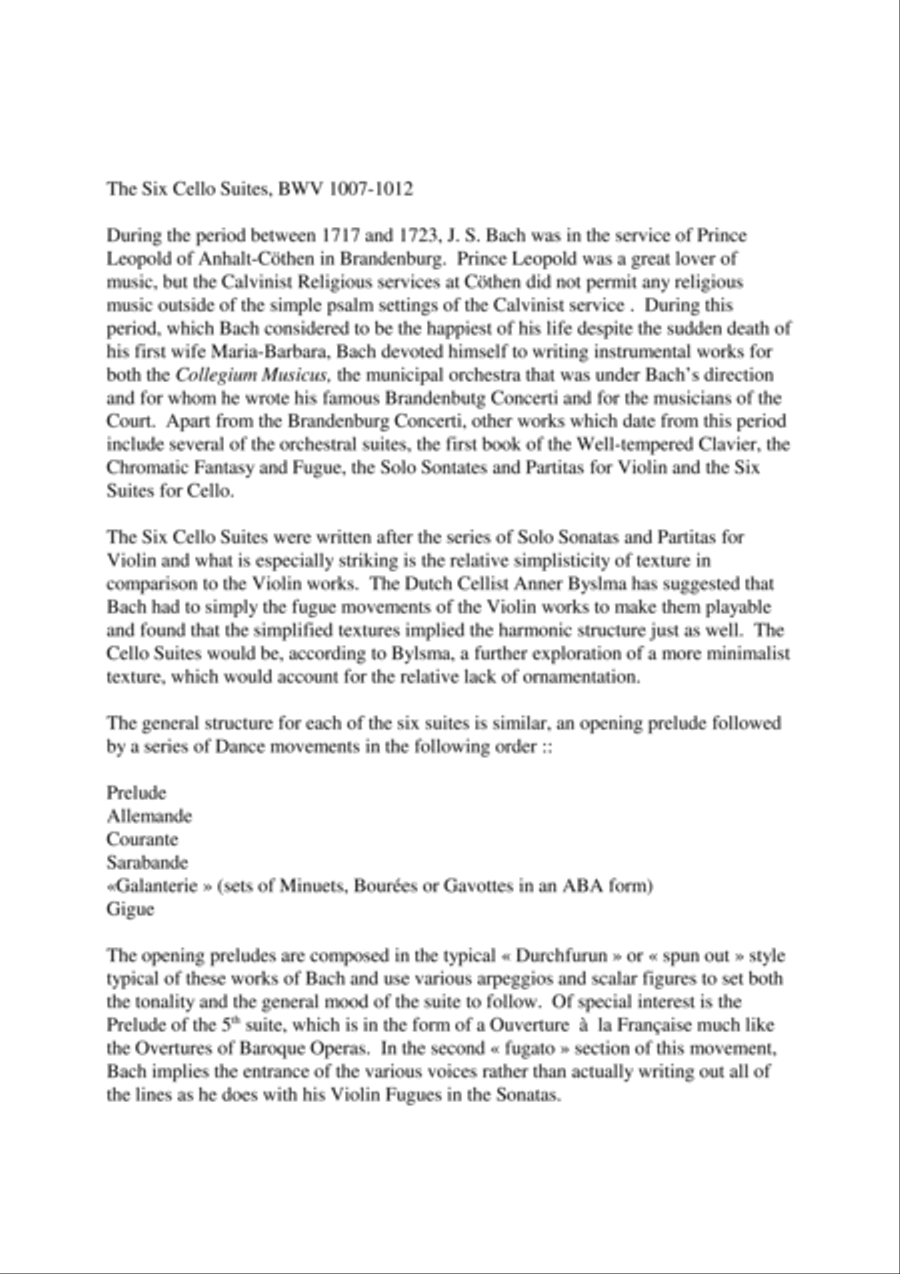
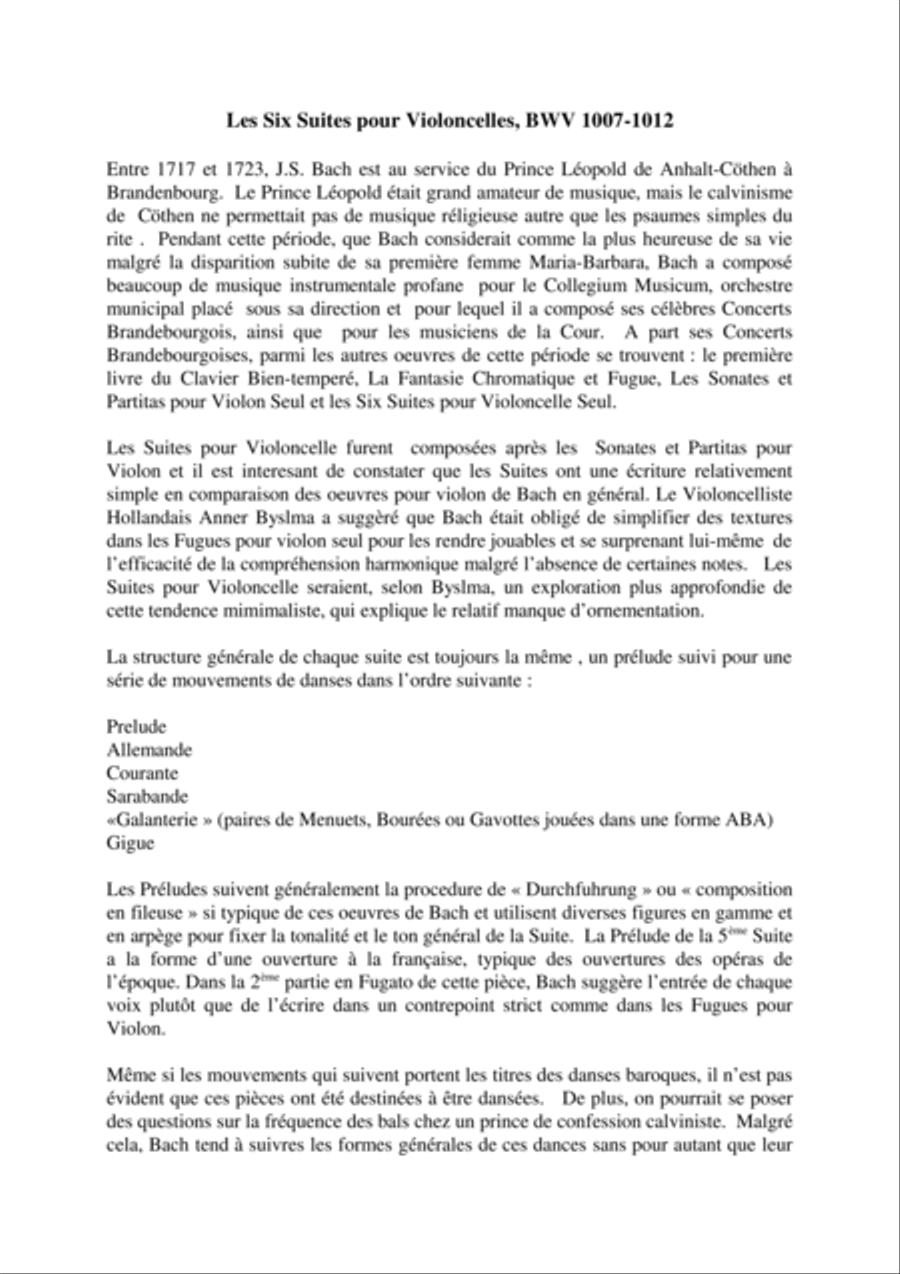
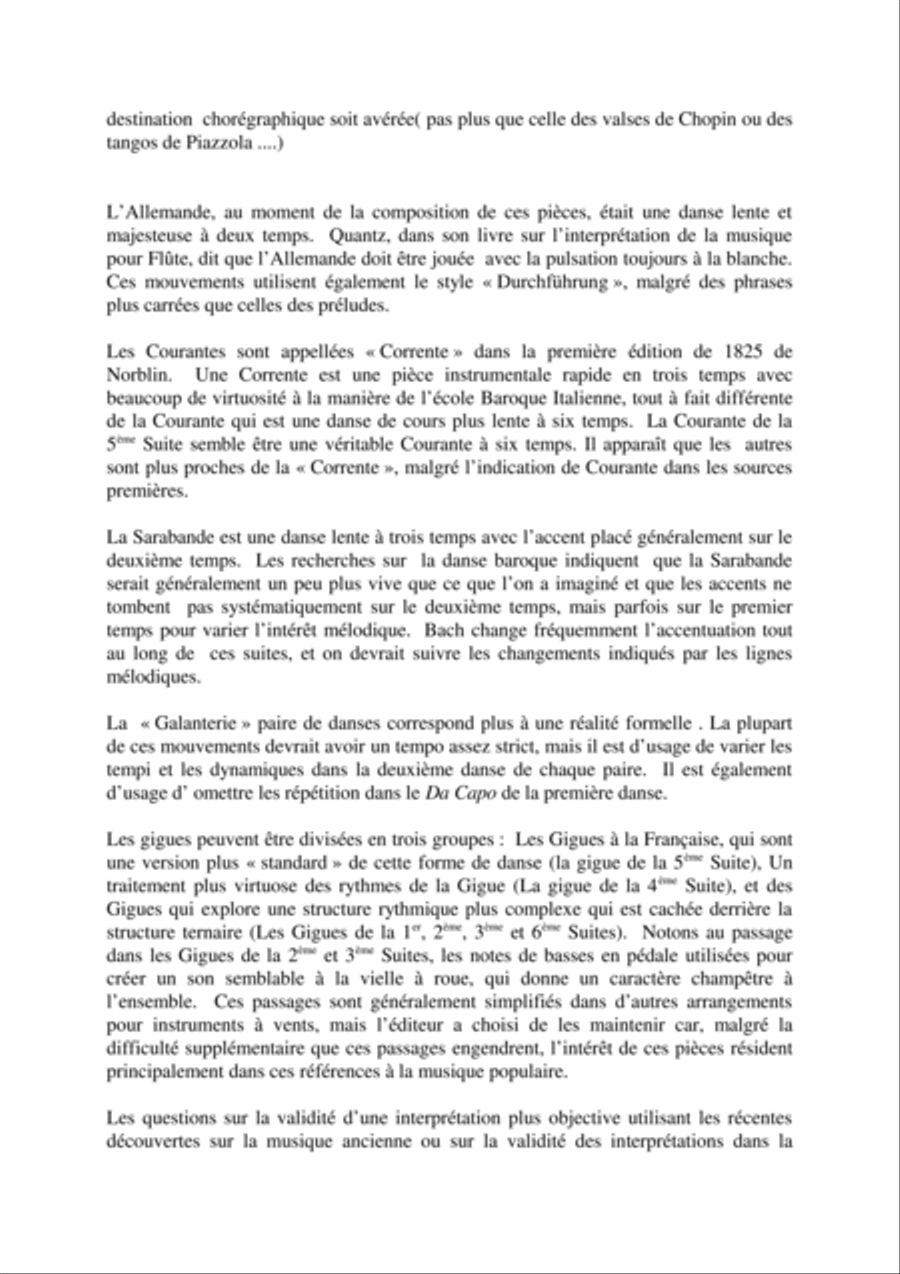
By Johann Sebastian BachDuring the period between 1717 and 1723, J. S. Bach was in the service of PrinceLeopold of Anhalt-Cöthen in Brandenburg. Prince Leopold was a great lover ofmusic, but the Calvinist Religious services at Cöthen did not permit any religiousmusic outside of the simple psalm settings of the Calvinist service . During thisperiod, which Bach considered to be the happiest of his life despite the sudden death ofhis first wife Maria-Barbara, Bach devoted himself to writing instrumental works forboth the Collegium Musicus, the municipal orchestra that was under Bach’s directionand for whom he wrote his famous Brandenbutg Concerti and for the musicians of theCourt. Apart from the Brandenburg Concerti, other works which date from this periodinclude several of the orchestral suites, the first book of the Well-tempered Clavier, theChromatic Fantasy and Fugue, the Solo Sontates and Partitas for Violin and the SixSuites for Cello.The Six Cello Suites were written after the series of Solo Sonatas and Partitas forViolin and what is especially striking is the relative simplisticity of texture incomparison to the Violin works. The Dutch Cellist Anner Byslma has suggested thatBach had to simply the fugue movements of the Violin works to make them playableand found that the simplified textures implied the harmonic structure just as well. TheCello Suites would be, according to Bylsma, a further exploration of a more minimalisttexture, which would account for the relative lack of ornamentation.The general structure for each of the six suites is similar, an opening prelude followedby a series of Dance movements in the following order ::PreludeAllemandeCouranteSarabande«Galanterie » (sets of Minuets, Bourées or Gavottes in an ABA form)GigueThe opening preludes are composed in the typical « Durchfurun » or « spun out » styletypical of these works of Bach and use various arpeggios and scalar figures to set boththe tonality and the general mood of the suite to follow. Of special interest is thePrelude of the 5th suite, which is in the form of a Ouverture à la Française much likethe Overtures of Baroque Operas. In the second « fugato » section of this movement,Bach implies the entrance of the various voices rather than actually writing out all ofthe lines as he does with his Violin Fugues in the Sonatas.While the particular movements which follow carry the titles of Baroque Dances, it isdoubtful whether they were actually intended to be music for Dance. Indeed, onemight be tempted to wonder just how much dancing was done at the court of aCalvinist Prince. However, Bach does follow the general forms of the dance works,although they do not seem to be ideally suited for Baroque Dance.The Allemande during the time of these compositions was a slow, stately dance induple time. Quantz, in his book of Flute performance practice, says that the Allemandeshould always be played with the beat on the half note. These movements also tend toexploit the « Durchfuhrun » style with a clearer phrase structure than the Preludes.The Courante movements were refered to as « Corrente » in the first published editionof 1825 by Norblin. The « Corrente » is a rapid virtuoso instrumental work in 3/4influenced by the Italian school, as opposed to the slower Courante which was aFrench Court Dance which was danced in Six beats to the measure. The Courante ofthe 5th Suite would seem to be more of a true Courante. It would seem that the otherswere more influenced by the « Corrente » style, although they are clearly marked as« Courante » in the manuscript sources.The Sarabande is a slow dance in ¾ with the usual accents falling on the second beat.The study of Baroque Dance would indicate that the Sarabande is a bit more rapid thanhas genera
Details
Summary
- Instrument:
- Cello Tenor Saxophone Soprano Saxophone Baritone Saxophone Alto Saxophone Saxophone Solo
- Ensembles:
- Woodwind Quartet Woodwind Ensemble
- Genres:
- Baroque Period Standards
- Composers:
- Johann Sebastian Bach
- Publishers:
- Musik Fabrik Music Publishing
- Series:
- ArrangeMe
- Format:
- Score and Parts
- Item types:
- Digital
- Instructionals:
- Methods and More
- Level:
- Advanced
- Musical forms:
- Suite
- Artist:
- Johann Sebastian Bach
- Arrangers:
- Paul Wehage
- Usages:
- School and Community
- Number of Pages:
- 88
Detailed Description
SKU: A0.534120
Composed by Johann Sebastian Bach. Arranged by Paul Wehage. Baroque,Concert,Instructional,Standards. 88 pages. Musik Fabrik Music Publishing #3121249. Published by Musik Fabrik Music Publishing (A0.534120).During the period between 1717 and 1723, J. S. Bach was in the service of Prince
Leopold of Anhalt-Cöthen in Brandenburg. Prince Leopold was a great lover of
music, but the Calvinist Religious services at Cöthen did not permit any religious
music outside of the simple psalm settings of the Calvinist service . During this
period, which Bach considered to be the happiest of his life despite the sudden death of
his first wife Maria-Barbara, Bach devoted himself to writing instrumental works for
both the Collegium Musicus, the municipal orchestra that was under Bach’s direction
and for whom he wrote his famous Brandenbutg Concerti and for the musicians of the
Court. Apart from the Brandenburg Concerti, other works which date from this period
include several of the orchestral suites, the first book of the Well-tempered Clavier, the
Chromatic Fantasy and Fugue, the Solo Sontates and Partitas for Violin and the Six
Suites for Cello.
The Six Cello Suites were written after the series of Solo Sonatas and Partitas for
Violin and what is especially striking is the relative simplisticity of texture in
comparison to the Violin works. The Dutch Cellist Anner Byslma has suggested that
Bach had to simply the fugue movements of the Violin works to make them playable
and found that the simplified textures implied the harmonic structure just as well. The
Cello Suites would be, according to Bylsma, a further exploration of a more minimalist
texture, which would account for the relative lack of ornamentation.
The general structure for each of the six suites is similar, an opening prelude followed
by a series of Dance movements in the following order ::
Prelude
Allemande
Courante
Sarabande
«Galanterie » (sets of Minuets, Bourées or Gavottes in an ABA form)
Gigue
The opening preludes are composed in the typical « Durchfurun » or « spun out » style
typical of these works of Bach and use various arpeggios and scalar figures to set both
the tonality and the general mood of the suite to follow. Of special interest is the
Prelude of the 5th suite, which is in the form of a Ouverture à la Française much like
the Overtures of Baroque Operas. In the second « fugato » section of this movement,
Bach implies the entrance of the various voices rather than actually writing out all of
the lines as he does with his Violin Fugues in the Sonatas.
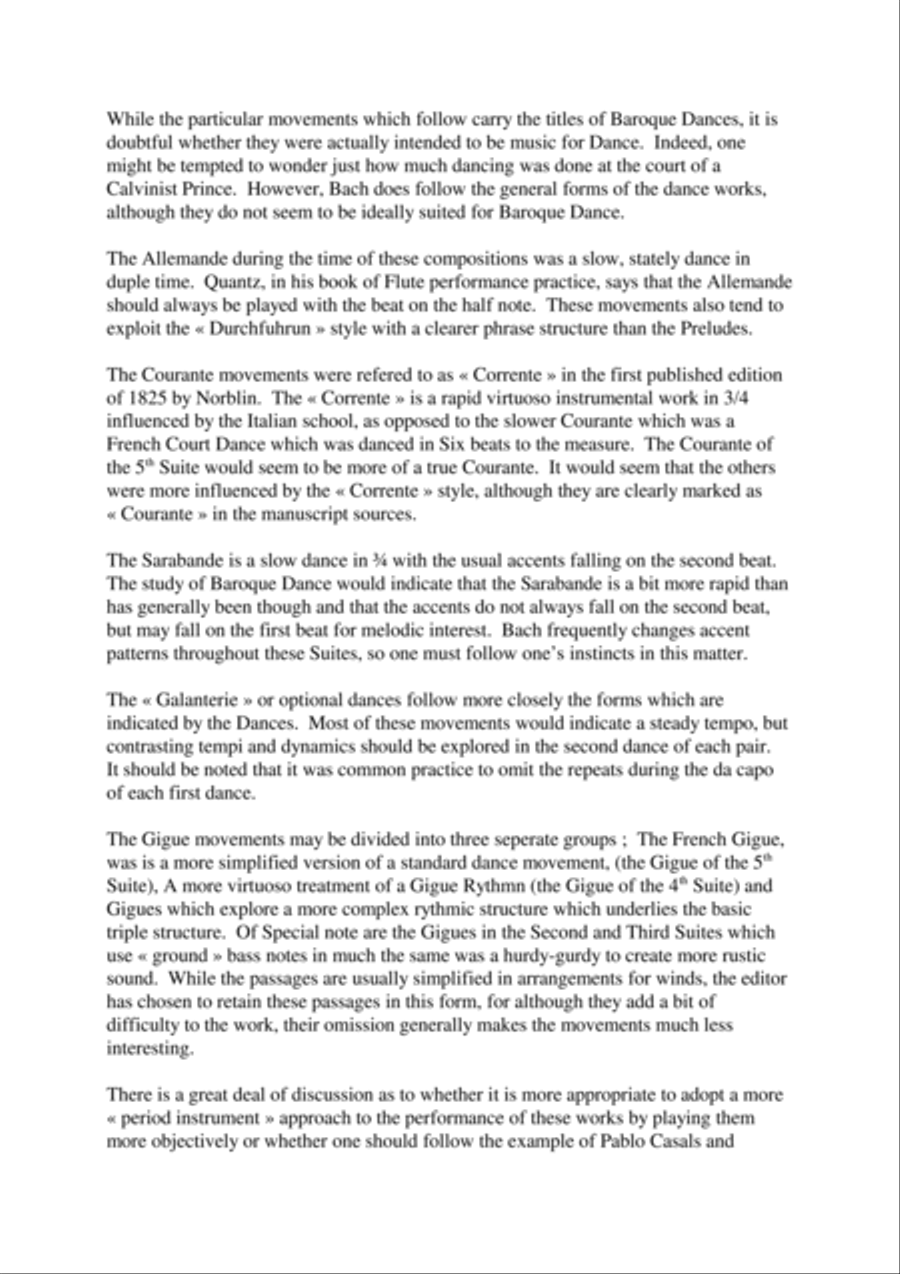
While the particular movements which follow carry the titles of Baroque Dances, it is
doubtful whether they were actually intended to be music for Dance. Indeed, one
might be tempted to wonder just how much dancing was done at the court of a
Calvinist Prince. However, Bach does follow the general forms of the dance works,
although they do not seem to be ideally suited for Baroque Dance.
The Allemande during the time of these compositions was a slow, stately dance in
duple time. Quantz, in his book of Flute performance practice, says that the Allemande
should always be played with the beat on the half note. These movements also tend to
exploit the « Durchfuhrun » style with a clearer phrase structure than the Preludes.
The Courante movements were refered to as « Corrente » in the first published edition
of 1825 by Norblin. The « Corrente » is a rapid virtuoso instrumental work in 3/4
influenced by the Italian school, as opposed to the slower Courante which was a
French Court Dance which was danced in Six beats to the measure. The Courante of
the 5th Suite would seem to be more of a true Courante. It would seem that the others
were more influenced by the « Corrente » style, although they are clearly marked as
« Courante » in the manuscript sources.
The Sarabande is a slow dance in ¾ with the usual accents falling on the second beat.
The study of Baroque Dance would indicate that the Sarabande is a bit more rapid than
has genera.
About ArrangeMe
This product was created by a member of ArrangeMe, Hal Leonard's self-publishing community for independent composers, arrangers, and songwriters. Discover unique arrangements of popular titles and original compositions from diverse creators. The length, difficulty, and pricing are determined by the arranger or composer.
About Digital Downloads
Digital Downloads let you instantly access sheet music on your computer, tablet, or mobile device. Print your sheet music anywhere, anytime, or play it straight from your device—no internet connection is required after download.
Each Digital Download includes a watermark with your name, purchase date, and the number of copies purchased. You may only print or use the number of copies purchased. Redistribution or unauthorized printing is prohibited.
Similar Sheet Music & Digital Downloads
- More by this Composer:
- Johann Sebastian Bach Johann Sebastian Bach Piano Johann Sebastian Bach Piano Accompaniment Johann Sebastian Bach Piano Solo
- ArrangeMe:
- Musik Fabrik Music Publishing
- Series:
- ArrangeMe
- Instrument:
- Strings Cello Woodwinds Saxophone Tenor Saxophone Woodwinds Saxophone Soprano Saxophone Woodwinds Saxophone Baritone Saxophone Woodwinds Saxophone Alto Saxophone Woodwinds Saxophone Saxophone Solo
- Artists:
- Johann Sebastian Bach Paul Wehage
- Ensemble:
- Woodwind Quartet Woodwind Ensemble
- Publisher:
- Musik Fabrik Music Publishing