Dreissig Spielstuecke / Orgelsonate (Trio) op. 18, 1+2 Centennial Jubilee Edition by Hugo Distler Organ - Sheet Music
By Hugo DistlerHugo Distler studied organ with Günther Ramin and composition with Hermann Grabner in Leipzig .He then worked as cantor and organist at St. Jacobi in Lübeck and taught composition and organ at the Stuttgart Musikhochschule from 1937 onwards.In 1940 he took up the same position at the Berlin Musikhochschule and also became director of the Berlin Cathedral Choir in 1941.Considerably influenced by the Lübeck Stellwagen organ at St. Jacobi, he championed the characteristic pre-Baroque and Baroque sound of the organ and the forms which best suited it. His stylistic preference was for a specifically neo-Baroque, functional-objective type of sound.This critical edition with previously unpublished works includes the forewords of the first editions, facsimiles, a critical commentary for each volume as well as a list of sources.
Details
Summary
- Instrument:
- Organ Organ Solo
- Genres:
- 20th Century
- Composers:
- Hugo Distler
- Publishers:
- Baerenreiter Verlag
- ISBN:
- 9790006534463
- Format:
- Performance Score
- Item types:
- Physical
- Level:
- Beginning
- Musical forms:
- Sonata
- Series levels:
- Grade 1
- Artist:
- Hugo Distler
- Usages:
- School and Community
- Size:
- 9.45 x 12.01 inches
- Shipping Weight:
- 1.05 pounds
Detailed Description
SKU: BA.BA09233
Band III. Centennial Jubilee Edition. Composed by Hugo Distler. Edited by Armin Schoof. This edition: urtext edition. Paperback. Hugo Distler. New Edition of the Complete Organ Works III | BARENREITER URTEXT. Edition for Distler's 100th anniversary. Performance score. Opus 18, 1. Baerenreiter Verlag #BA09233. Published by Baerenreiter Verlag (BA.BA09233).ISBN 9790006534463. 9.45 x 12.01 inches.
Hugo Distler studied organ with Günther Ramin and composition with Hermann Grabner in Leipzig .
He then worked as cantor and organist at St. Jacobi in Lübeck and taught composition and organ at the Stuttgart Musikhochschule from 1937 onwards.
In 1940 he took up the same position at the Berlin Musikhochschule and also became director of the Berlin Cathedral Choir in 1941.
Considerably influenced by the Lübeck Stellwagen organ at St. Jacobi, he championed the characteristic pre-Baroque and Baroque sound of the organ and the forms which best suited it. His stylistic preference was for a specifically neo-Baroque, functional-objective type of sound.
This critical edition with previously unpublished works includes the forewords of the first editions, facsimiles, a critical commentary for each volume as well as a list of sources.
About Barenreiter Urtext
What can I expect from a Barenreiter Urtext edition?
MUSICOLOGICALLY SOUND
- A reliable musical text based on all available sources
- A description of the sources
- Information on the genesis and history of the work
- Valuable notes on performance practice
- Includes an introduction with critical commentary explaining source discrepancies and editorial decisions
... AND PRACTICAL
- Page-turns, fold-out pages, and cues where you need them
- A well-presented layout and a user-friendly format
- Excellent print quality
- Superior paper and binding
Song List
Preface
Hugo Distler and his Organ Works
Distler's Organ Style
The Stuttgart Organ Works op. 18, nos. 1 and 2
Specification of the House Organ
Photographs
Facsimiles
Thirty Pieces for Small Organ or other Keyboard Instruments op. 18, no. 1
Nr. 1-4
Nr. 5-11
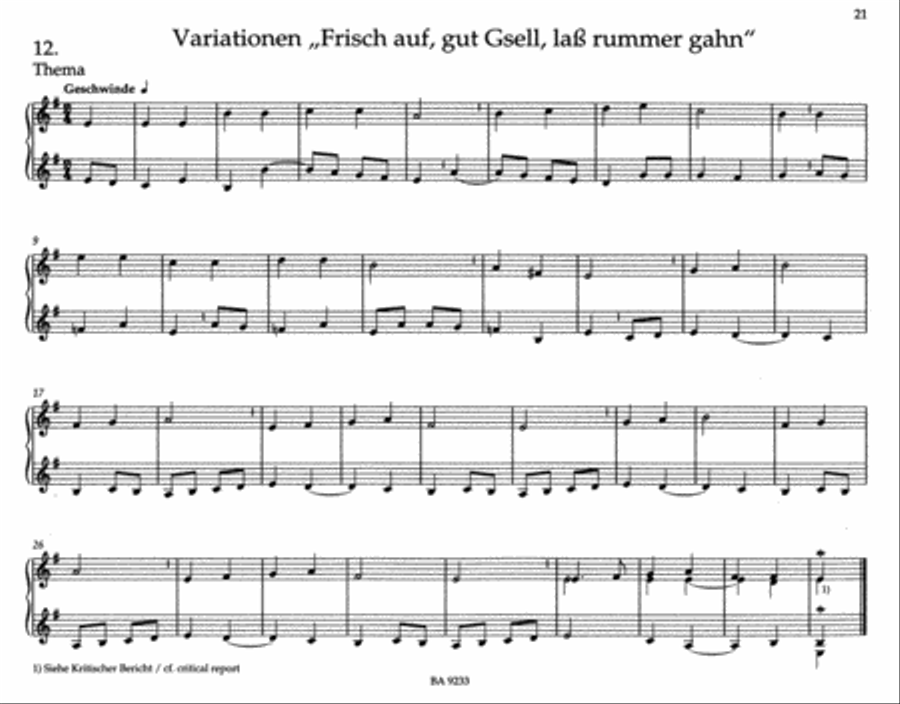
Nr. 12-17: Variations Fisch auf, gut Gsell, lass rummer gahn
Nr. 18-24: Variations Elselein, liebstes Elselein
Nr. 25-30: Variations Wo Gott zu Haus nit givt sein Gunst
Epilogue of the First Edition
The Editor's Comment on the Epiloguue of the First Edition
Organ Sonata (Trio), op. 18, no. 2
Performance Instructions of the First Edition
I. Quick, energetic half notes
II. Introduction
III. Rather fast eighth notes
Critical Report
I. Abbreviations
II. Editorial Policies
III. Sources
IV. Detailed references
Glossary (the composer's performance instructions)
Similar Sheet Music & Digital Downloads
- More by this Composer:
- Hugo Distler Hugo Distler Choir Hugo Distler Organ Hugo Distler Voice
- Instrument:
- Piano and Keyboard Organ Piano and Keyboard Organ Organ Solo
- Artists:
- Hugo Distler Armin Schoof
- Publisher:
- Baerenreiter Verlag