Dover Beach Tales from the North Choir - Sheet Music
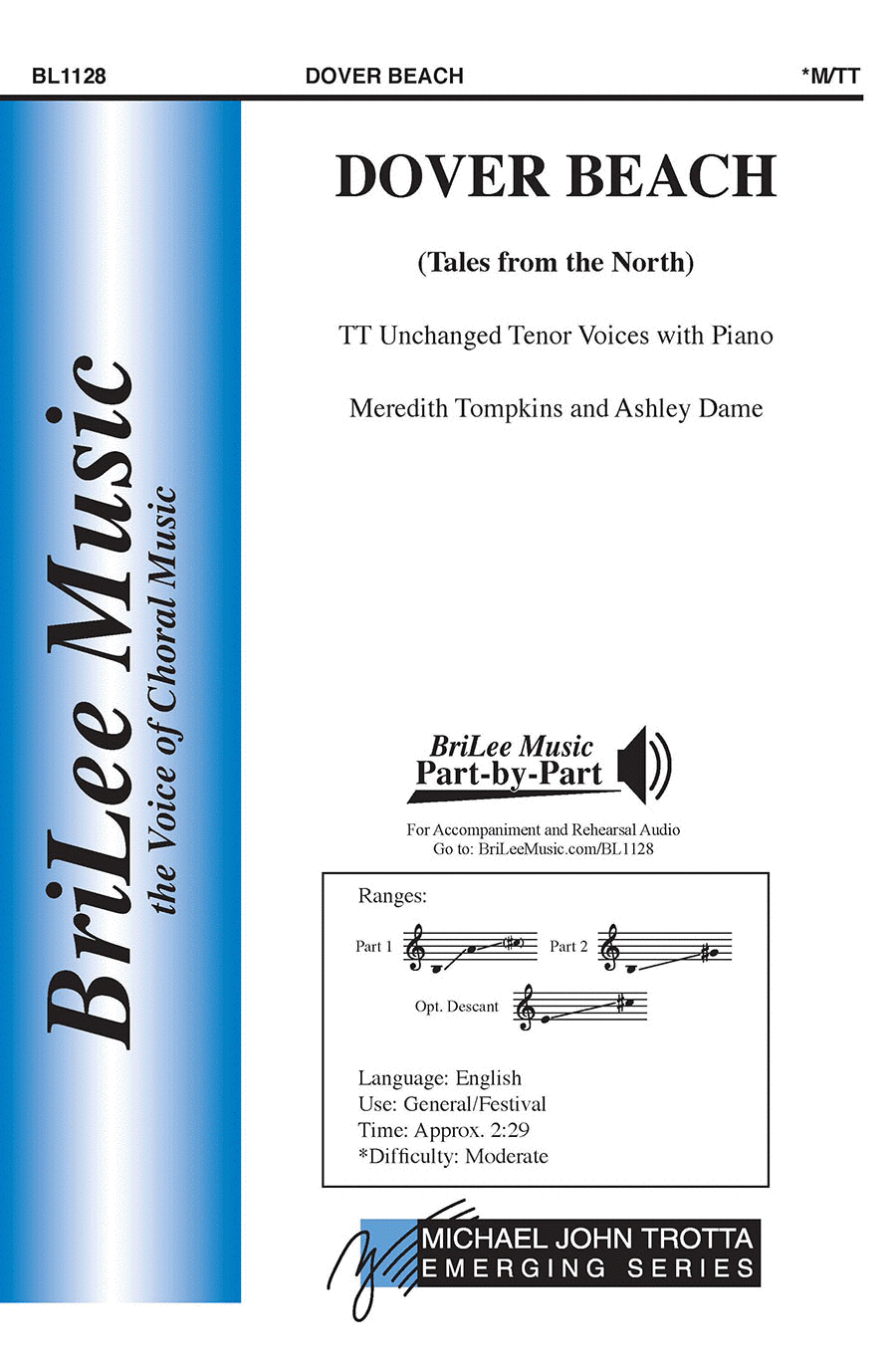
For unchanged tenor voices, Dover Beach contains rolling and weaving melodies within the framework of an undulating piano accompaniment. Energetic and musically charged, the driving melodic passages will challenge the young tenor performers to be their very best!.The luminous text of the poem Dover Beach by English poet Matthew Arnold is the inspiration for the rolling and weaving melodies of this undulating piece. In his writing, Arnold ponders how the vastness of the sea and the thrashing waves that crash on the sand and rocks seem to mirror the melancholy in his heart. He comes back to the steadfast nature of the cliffs of England that allow the light of the moon to gleam across and then scatter into darkness. The echoing phrases are intended to create concrete repetitions that mirror the original unison melody with minor deviations. In turn, the driving passages will challenge the young performer while providing arpeggiated accompaniment to propel the singer forward. INSTRUCTIONAL PURPOSES and RANGES: This piece is written specifically to provide a comfortable tessitura for Unchanged, Stage I, and Stage II emerging male voices. The descant portion may be sung by unchanged voices from a small ensemble, as a solo, or omitted completely. Range: Part I Range: Part II Range: Optional Descant Stage I Stage I and II* Unchanged *Although the ranges are the same for both Part I and II, the tessitura for Part II is lower overall and thus is closer to Stage II.The luminous text of the poem Dover Beach by English poet Matthew Arnold is the inspiration for the rolling and weaving melodies of this undulating piece. In his writing, Arnold ponders how the vastness of the sea and the thrashing waves that crash on the sand and rocks seem to mirror the melancholy in his heart. He comes back to the steadfast nature of the cliffs of England that allow the light of the moon to gleam across and then scatter into darkness. The echoing phrases are intended to create concrete repetitions that mirror the original unison melody with minor deviations. In turn, the driving passages will challenge the young performer while providing arpeggiated accompaniment to propel the singer forward.INSTRUCTIONAL PURPOSES and RANGES:This piece is written specifically to provide a comfortable tessitura for Unchanged, Stage I, and Stage II emerging male voices. The descant portion may be sung by unchanged voices from a small ensemble, as a solo, or omitted completely.Range: Part I Range: Part II Range: Optional DescantStage I Stage I and II* Unchanged*Although the ranges are the same for both Part I and II, the tessitura for Part II is lower overall and thus is closer to Stage II.
Details
Summary
- Instrument:
- Choir Tenor Voice Voice Solo
- Ensembles:
- Choir
- Publishers:
- BriLee Music
- UPC:
- 680160912391
- Format:
- Octavo
- Item types:
- Physical
- Usages:
- School and Community
- Main Key:
- E major,B minor
- Number of Pages:
- 12
- Size:
- 6.875 x 10.5 inches
- Shipping Weight:
- 0.63 pounds
Detailed Description
SKU: CF.BL1128
Tales from the North. Composed by Meredith Tompkins; Ashley Dame. Octavo. Mjte. Octavo. 12 pages. Duration 2:29. BriLee Music #BL1128. Published by BriLee Music (CF.BL1128).UPC: 680160912391. 6.875 x 10.5 inches. Key: E major,b minor. English. Matthew Arnold (1822-1888).
For unchanged tenor voices, Dover Beach contains rolling and weaving melodies within the framework of an undulating piano accompaniment. Energetic and musically charged, the driving melodic passages will challenge the young tenor performers to be their very best!.
The luminous text of the poem Dover Beach by English poet Matthew Arnold is the inspiration for the rolling and weaving melodies of this undulating piece. In his writing, Arnold ponders how the vastness of the sea and the thrashing waves that crash on the sand and rocks seem to mirror the melancholy in his heart. He comes back to the steadfast nature of the cliffs of England that allow the light of the moon to gleam across and then scatter into darkness. The echoing phrases are intended to create concrete repetitions that mirror the original unison melody with minor deviations. In turn, the driving passages will challenge the young performer while providing arpeggiated accompaniment to propel the singer forward. INSTRUCTIONAL PURPOSES and RANGES: This piece is written specifically to provide a comfortable tessitura for Unchanged, Stage I, and Stage II emerging male voices. The descant portion may be sung by unchanged voices from a small ensemble, as a solo, or omitted completely. Range: Part I Range: Part II Range: Optional Descant Stage I Stage I and II* Unchanged *Although the ranges are the same for both Part I and II, the tessitura for Part II is lower overall and thus is closer to Stage II.
The luminous text of the poem Dover Beach by English poet Matthew Arnold is the inspiration for the rolling and weaving melodies of this undulating piece. In his writing, Arnold ponders how the vastness of the sea and the thrashing waves that crash on the sand and rocks seem to mirror the melancholy in his heart. He comes back to the steadfast nature of the cliffs of England that allow the light of the moon to gleam across and then scatter into darkness. The echoing phrases are intended to create concrete repetitions that mirror the original unison melody with minor deviations. In turn, the driving passages will challenge the young performer while providing arpeggiated accompaniment to propel the singer forward.INSTRUCTIONAL PURPOSES and RANGES:This piece is written specifically to provide a comfortable tessitura for Unchanged, Stage I, and Stage II emerging male voices. The descant portion may be sung by unchanged voices from a small ensemble, as a solo, or omitted completely.Range: Part I Range: Part II Range: Optional DescantStage I Stage I and II* Unchanged*Although the ranges are the same for both Part I and II, the tessitura for Part II is lower overall and thus is closer to Stage II.
Similar Sheet Music & Digital Downloads
- Instrument:
- Vocal Choir Vocal Voice Tenor Voice Vocal Voice Voice Solo
- Ensemble:
- Choir
- Publisher:
- BriLee Music