David Hurd: Te Deum Laudamus for organ by David Hurd Organ Solo - Digital Sheet Music
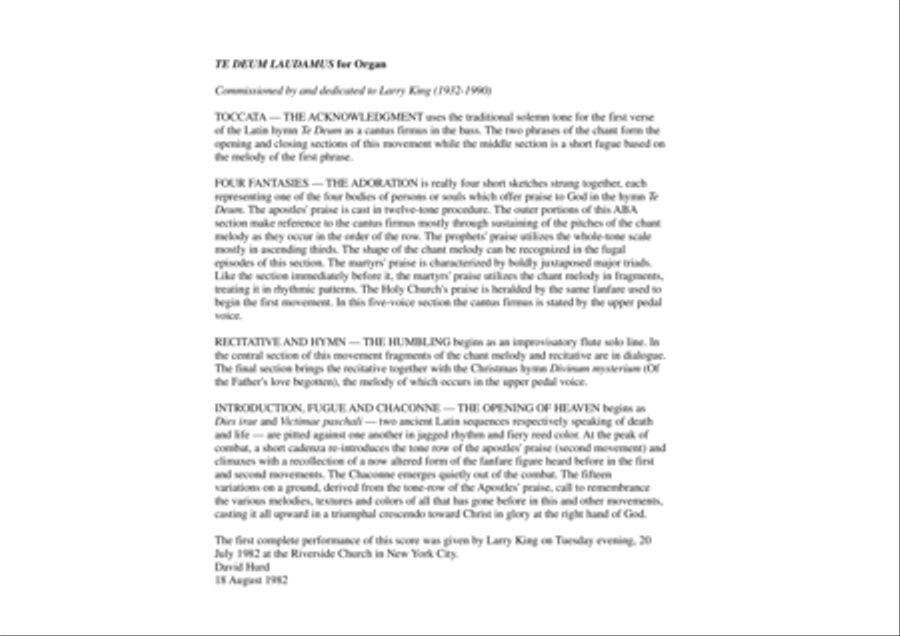
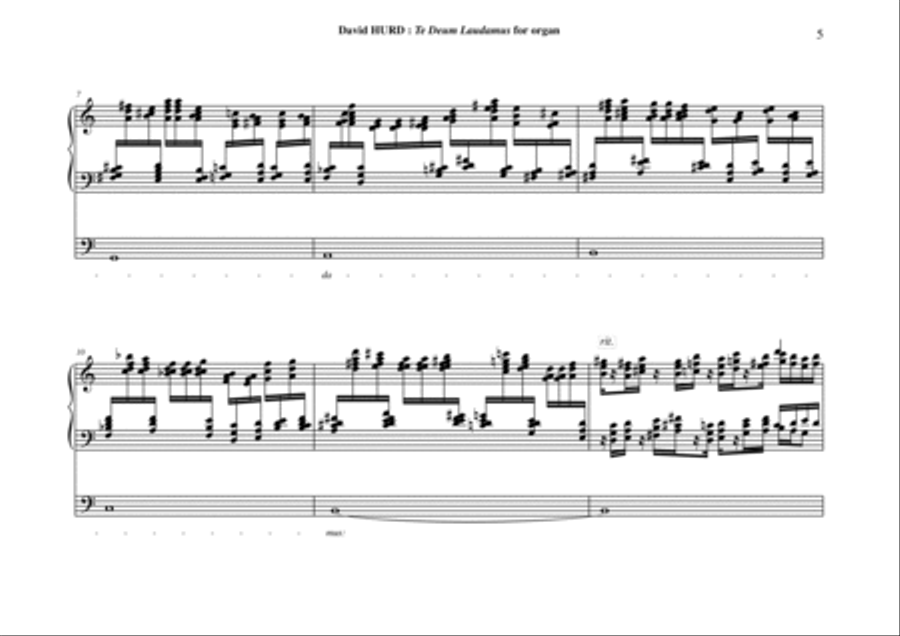
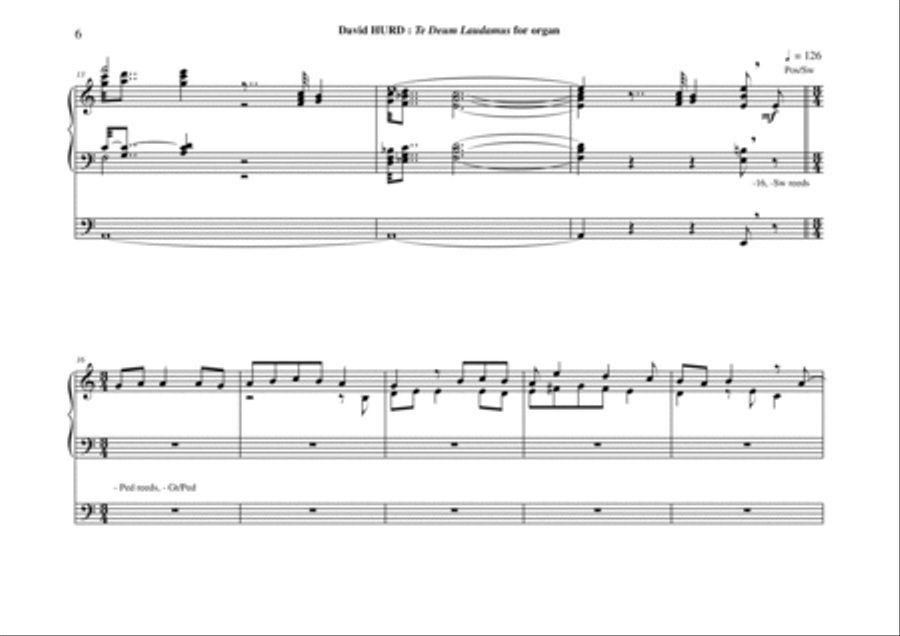
By David HurdTE DEUM LAUDAMUS for OrganCommissioned by and dedicated to Larry King (1932-1990)TOCCATA — THE ACKNOWLEDGMENT uses the traditional solemn tone for the first verse of the Latin hymn Te Deum as a cantus firmus in the bass. The two phrases of the chant form the opening and closing sections of this movement while the middle section is a short fugue based on the melody of the first phrase.FOUR FANTASIES — THE ADORATION is really four short sketches strung together, each representing one of the four bodies of persons or souls which offer praise to God in the hymn Te Deum. The apostles' praise is cast in twelve-tone procedure. The outer portions of this ABA section make reference to the cantus firmus mostly through sustaining of the pitches of the chant melody as they occur in the order of the row. The prophets' praise utilizes the whole-tone scale mostly in ascending thirds. The shape of the chant melody can be recognized in the fugal episodes of this section. The martyrs' praise is characterized by boldly juxtaposed major triads. Like the section immediately before it, the martyrs' praise utilizes the chant melody in fragments, treating it in rhythmic patterns. The Holy Church's praise is heralded by the same fanfare used to begin the first movement. In this five-voice section the cantus firmus is stated by the upper pedal voice.RECITATIVE AND HYMN — THE HUMBLING begins as an improvisatory flute solo line. In the central section of this movement fragments of the chant melody and recitative are in dialogue. The final section brings the recitative together with the Christmas hymn Divinum mysterium (Of the Father's love begotten), the melody of which occurs in the upper pedal voice.INTRODUCTION, FUGUE AND CHACONNE — THE OPENING OF HEAVEN begins as Dies irae and Victimae paschali — two ancient Latin sequences respectively speaking of death and life — are pitted against one another in jagged rhythm and fiery reed color. At the peak of combat, a short cadenza re-introduces the tone row of the apostles' praise (second movement) and climaxes with a recollection of a now altered form of the fanfare figure heard before in the first and second movements. The Chaconne emerges quietly out of the combat. The fifteen variations on a ground, derived from the tone-row of the Apostles' praise, call to remembrance the various melodies, textures and colors of all that has gone before in this and other movements, casting it all upward in a triumphal crescendo toward Christ in glory at the right hand of God.The first complete performance of this score was given by Larry King on Tuesday evening, 20 July 1982 at the Riverside Church in New York City.David Hurd 18 August 1982
Details
Summary
- Instrument:
- Organ Solo
- Genres:
- 20th Century Standards Contemporary
- Composers:
- David Hurd
- Publishers:
- Musik Fabrik Music Publishing
- Format:
- Score
- Item types:
- Digital
- Level:
- Late Intermediate
- Artist:
- David Hurd
- Usages:
- Praise
- Number of Pages:
- 71
Detailed Description
SKU: A0.533465
Composed by David Hurd. 20th Century,Concert,Contemporary,Sacred,Standards. Score. 71 pages. Musik Fabrik Music Publishing #2991173. Published by Musik Fabrik Music Publishing (A0.533465).TE DEUM LAUDAMUS for Organ
Commissioned by and dedicated to Larry King (1932-1990)
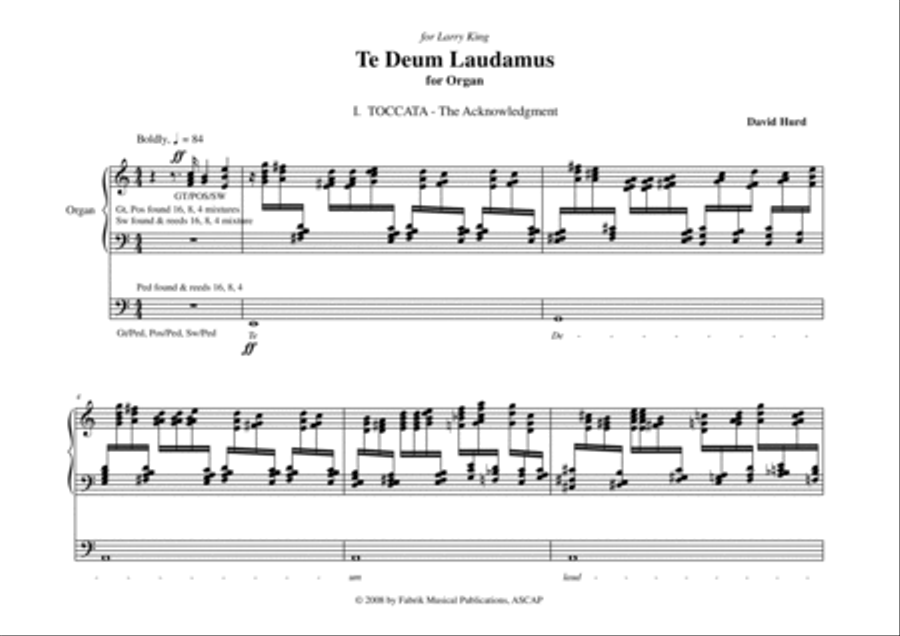
TOCCATA — THE ACKNOWLEDGMENT uses the traditional solemn tone for the first verse of the Latin hymn Te Deum as a cantus firmus in the bass. The two phrases of the chant form the opening and closing sections of this movement while the middle section is a short fugue based on the melody of the first phrase.
FOUR FANTASIES — THE ADORATION is really four short sketches strung together, each representing one of the four bodies of persons or souls which offer praise to God in the hymn Te Deum. The apostles' praise is cast in twelve-tone procedure. The outer portions of this ABA section make reference to the cantus firmus mostly through sustaining of the pitches of the chant melody as they occur in the order of the row. The prophets' praise utilizes the whole-tone scale mostly in ascending thirds. The shape of the chant melody can be recognized in the fugal episodes of this section. The martyrs' praise is characterized by boldly juxtaposed major triads. Like the section immediately before it, the martyrs' praise utilizes the chant melody in fragments, treating it in rhythmic patterns. The Holy Church's praise is heralded by the same fanfare used to begin the first movement. In this five-voice section the cantus firmus is stated by the upper pedal voice.
RECITATIVE AND HYMN — THE HUMBLING begins as an improvisatory flute solo line. In the central section of this movement fragments of the chant melody and recitative are in dialogue. The final section brings the recitative together with the Christmas hymn Divinum mysterium (Of the Father's love begotten), the melody of which occurs in the upper pedal voice.
INTRODUCTION, FUGUE AND CHACONNE — THE OPENING OF HEAVEN begins as Dies irae and Victimae paschali — two ancient Latin sequences respectively speaking of death and life — are pitted against one another in jagged rhythm and fiery reed color. At the peak of combat, a short cadenza re-introduces the tone row of the apostles' praise (second movement) and climaxes with a recollection of a now altered form of the fanfare figure heard before in the first and second movements. The Chaconne emerges quietly out of the combat. The fifteen variations on a ground, derived from the tone-row of the Apostles' praise, call to remembrance the various melodies, textures and colors of all that has gone before in this and other movements, casting it all upward in a triumphal crescendo toward Christ in glory at the right hand of God.
The first complete performance of this score was given by Larry King on Tuesday evening, 20 July 1982 at the Riverside Church in New York City.
David Hurd 18 August 1982
About ArrangeMe
This product was created by a member of ArrangeMe, Hal Leonard's self-publishing community for independent composers, arrangers, and songwriters. Discover unique arrangements of popular titles and original compositions from diverse creators. The length, difficulty, and pricing are determined by the arranger or composer.
About Digital Downloads
Digital Downloads let you instantly access sheet music on your computer, tablet, or mobile device. Print your sheet music anywhere, anytime, or play it straight from your device—no internet connection is required after download.
Each Digital Download includes a watermark with your name, purchase date, and the number of copies purchased. You may only print or use the number of copies purchased. Redistribution or unauthorized printing is prohibited.
Similar Sheet Music & Digital Downloads
- More by this Composer:
- David Hurd David Hurd Choir David Hurd Organ David Hurd Organ Accompaniment
- ArrangeMe:
- Musik Fabrik Music Publishing
- Instrument:
- Piano and Keyboard Organ Organ Solo
- Artists:
- David Hurd
- Publisher:
- Musik Fabrik Music Publishing