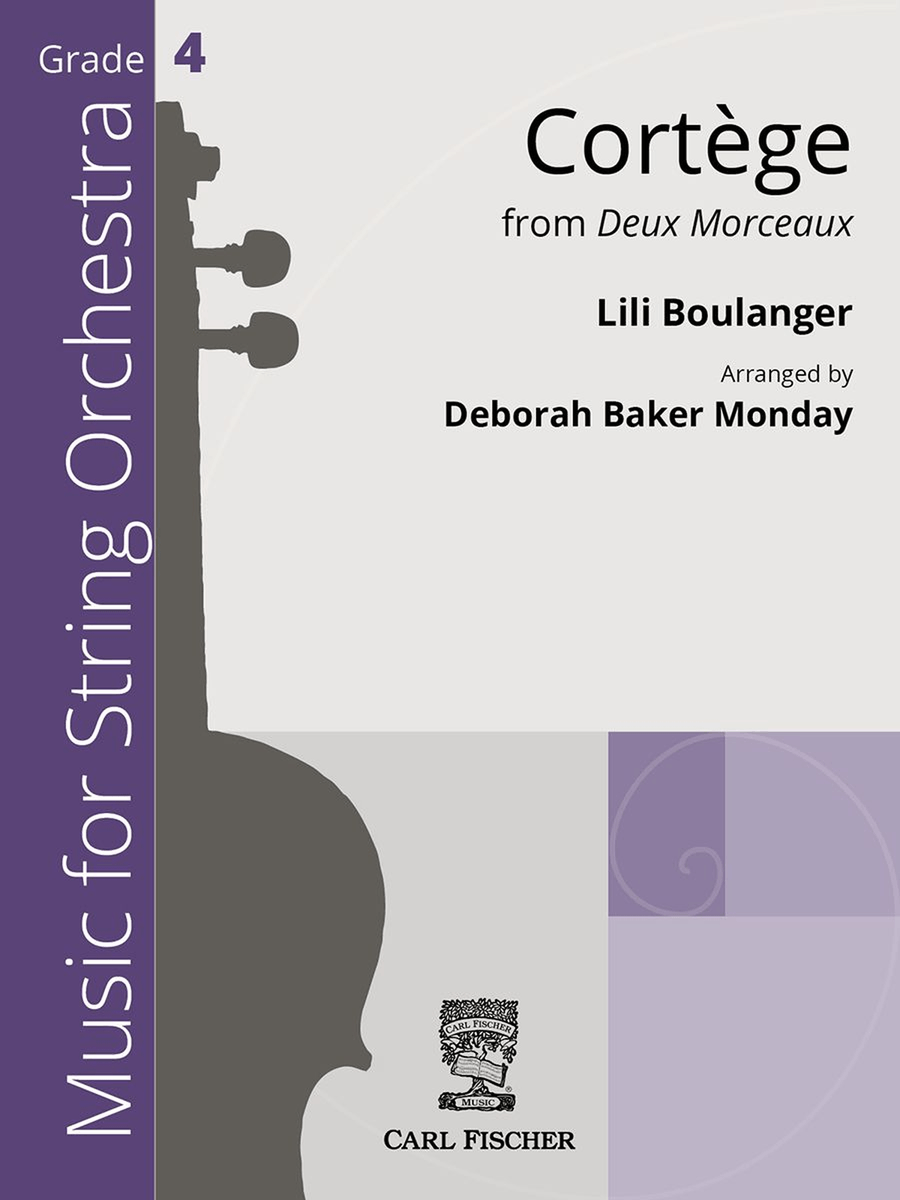
Cortège from Deux Morceaux by Juliette Marie Olga (Lili) Boulanger Orchestra - Sheet Music
By Juliette Marie Olga (Lili) BoulangerLili Boulanger (1893–1918) was a gifted French composer whose amazing talent became evident at an early age. Cortège is the third movement in “Trois Morceaux,” a set of pieces first composed for solo piano, but later arranged for violin and piano by the composer. Some of Lili’s writing idioms appear in Cortège such as harmonic shifts, free use of chromatics, and even subtle use of a whole tone scale. A cortege is a kind of procession, sometimes for a funeral, but in this case the procession is more upbeat and cheerful. .Lili Boulanger (1893–1918) was a gifted French composer whose amazing talent became evident at an early age. She was probably noticed while attending classes with her older sister Nadia. Nadia’s career became quite successful as a teacher to many soon to become famous composers such as Stravinsky, Copland, and many other American composers. But Lili’s composition abilities exceeded her older sister’s. Unfortunately, her career was cut short because she was plagued with illness. Her short life produced many award-winning compositions. Her style was uniquely late Romantic and leaning toward some Impressionist tendencies.Cortège is the second movement in the set of “Deux Morceaux” which was originally conceived as a piano solo. However, she shortly did an alternate version for violin and piano and that was how it was first performed in 1915. A few of Lili’s writing idioms appear in Cortège. There are harmonic shifts, free use of chromatics and even the use of a whole tone scale. A cortege is a kind of procession, sometimes for a funeral, but in this case the procession is more upbeat and cheerful. Lili became the first woman to win the prestigious Prix de Rome for composition in 1913, a landmark achievement in French cultural history.
Details
Summary
- Instrument:
- Cello Double Bass
- Ensembles:
- Orchestra
- Genres:
- 20th Century
- Composers:
- Juliette Marie Olga (Lili) Boulanger
- Publishers:
- Carl Fischer Music
- Series:
- Women Composers and Arrangers
- UPC:
- 798408102982
- ISBN:
- 9798299500387
- Format:
- Score Set of Parts Score and Parts
- Item types:
- Physical
- Level:
- Grade 4
- Arrangers:
- Deborah Baker Monday
- Usages:
- School and Community
- Main Key:
- G major
- Number of Pages:
- 118
- Size:
- 9x12 inches
- Shipping Weight:
- 1.11 pounds
Detailed Description
SKU: CF.STR36
From Deux Morceaux. Composed by Juliette Marie Olga (Lili) Boulanger. Arranged by Deborah Baker Monday. Folio. Score and parts. 118 pages. Duration 0:03:17. Carl Fischer Music #STR36. Published by Carl Fischer Music (CF.STR36).ISBN 9798299500387. UPC: 798408102982. 9x12 inches. Key: G major.
Lili Boulanger (1893–1918) was a gifted French composer whose amazing talent became evident at an early age. Cortège is the third movement in “Trois Morceaux,” a set of pieces first composed for solo piano, but later arranged for violin and piano by the composer. Some of Lili’s writing idioms appear in Cortège such as harmonic shifts, free use of chromatics, and even subtle use of a whole tone scale. A cortege is a kind of procession, sometimes for a funeral, but in this case the procession is more upbeat and cheerful. .
Lili Boulanger (1893–1918) was a gifted French composer whose amazing talent became evident at an early age. She was probably noticed while attending classes with her older sister Nadia. Nadia’s career became quite successful as a teacher to many soon to become famous composers such as Stravinsky, Copland, and many other American composers. But Lili’s composition abilities exceeded her older sister’s. Unfortunately, her career was cut short because she was plagued with illness. Her short life produced many award-winning compositions. Her style was uniquely late Romantic and leaning toward some Impressionist tendencies.Cortège is the second movement in the set of “Deux Morceaux” which was originally conceived as a piano solo. However, she shortly did an alternate version for violin and piano and that was how it was first performed in 1915. A few of Lili’s writing idioms appear in Cortège. There are harmonic shifts, free use of chromatics and even the use of a whole tone scale. A cortege is a kind of procession, sometimes for a funeral, but in this case the procession is more upbeat and cheerful. Lili became the first woman to win the prestigious Prix de Rome for composition in 1913, a landmark achievement in French cultural history.
Similar Sheet Music & Digital Downloads
- More by this Composer:
- Juliette Marie Olga (Lili) Boulanger Juliette Marie Olga (Lili) Boulanger Choir Juliette Marie Olga (Lili) Boulanger Piano Juliette Marie Olga (Lili) Boulanger Voice
- Series:
- Women Composers and Arrangers
- Instrument:
- Strings Cello Strings Double Bass
- Ensemble:
- Orchestra
- Publisher:
- Carl Fischer Music