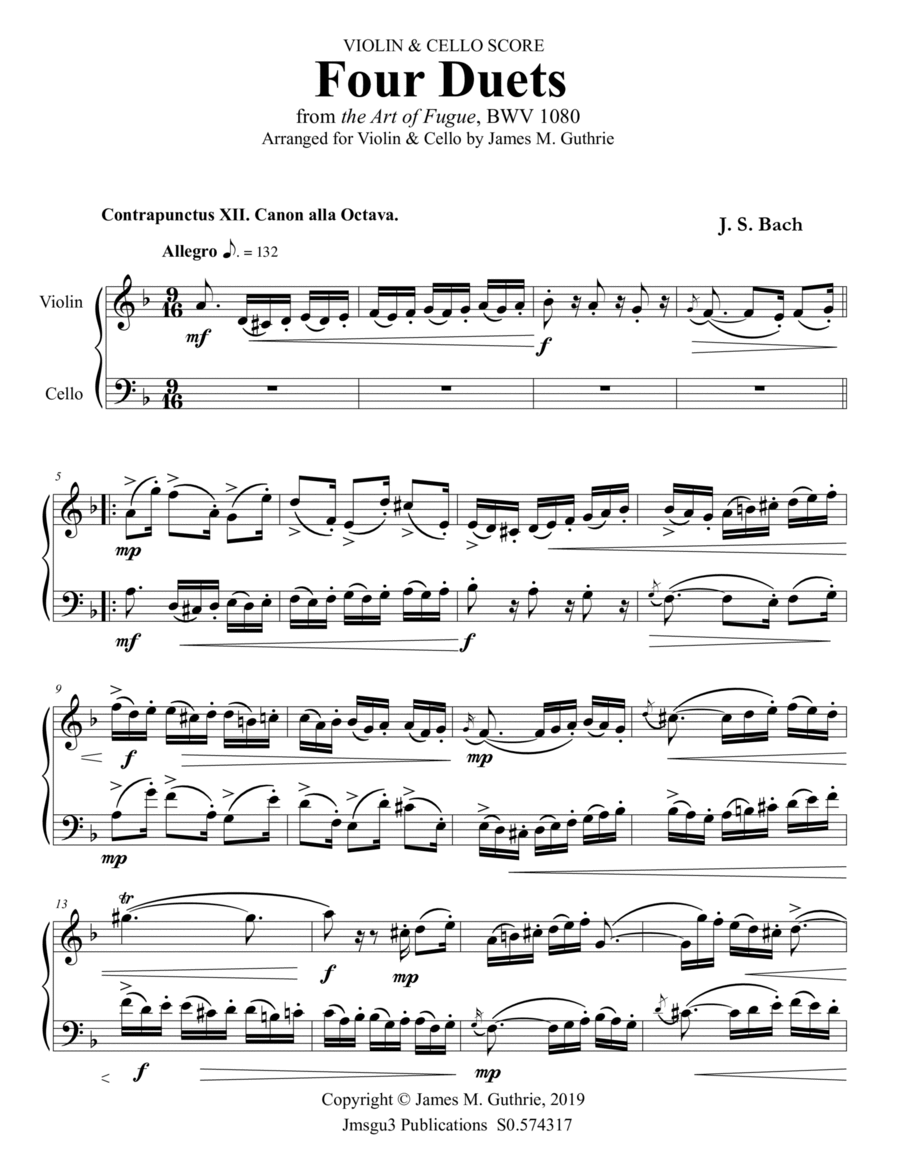


Bach: Four Duets from the Art of Fugue for Violin & Cello by Johann Sebastian Bach String Duet - Digital Sheet Music
By Johann Sebastian BachFour Duets from The Art of Fugue, BWV 1080. Contrapunctus XII Canon alla Octava. Contrapunctus XIII Canon alla Duodecima in Contrapunto alla Quinta. Contrapunctus XIV Canon alla Decima. Contrapunto alla Terza. Contrapunctus XV Canone per augmentation in motu contrario. The two-voiced canons in The Art of Fugue hold significant musical and compositional importance. Here are some key points about their significance:Contrapuntal Technique: Canons are a strict counterpoint where another voice imitates a melody after a specific duration. In The Art of Fugue, the canons demonstrate Bach's mastery of contrapuntal technique, showcasing his ability to create intricate musical structures by strictly imitating the central theme.Structural Development: The canons in The Art of Fugue contribute to the overall structural development of the work. They are presented as "perpetual canons," each voice perpetually imitates the other, showcasing the theme's adaptability and versatility.Increasing Complexity: The canons, along with the fugues, are generally ordered to increase in complexity, demonstrating Bach's skill in developing and manipulating musical themes.Debate on Performance: The significance of the canons is also reflected in the ongoing discussion among scholars about whether The Art of Fugue was intended for performance or as an intellectual exercise. This debate adds to the intrigue and significance of the work.In summary, the two-voiced canons in The Art of Fugue are significant for their demonstration of contrapuntal technique, their contribution to the structural development of the work, and their role in the scholarly debate about the intended purpose of The Art of Fugue.
Details
Summary
- Ensembles:
- String Duet
- Genres:
- Baroque Period Standards
- Composers:
- Johann Sebastian Bach
- Publishers:
- jmsgu3
- Series:
- ArrangeMe
- Format:
- Score and Parts
- Item types:
- Digital
- Instructionals:
- Methods and More
- Level:
- Intermediate
- Artist:
- Johann Sebastian Bach
- Arrangers:
- James M. Guthrie
- Usages:
- Sacred
- Number of Pages:
- 54
Detailed Description
SKU: A0.550335
Composed by Johann Sebastian Bach. Arranged by James M. Guthrie. Baroque,Instructional,Sacred,Standards. 54 pages. Jmsgu3 #4609713. Published by jmsgu3 (A0.550335).Four Duets from The Art of Fugue, BWV 1080.
The two-voiced canons in The Art of Fugue hold significant musical and compositional importance. Here are some key points about their significance:
Contrapuntal Technique: Canons are a strict counterpoint where another voice imitates a melody after a specific duration. In The Art of Fugue, the canons demonstrate Bach's mastery of contrapuntal technique, showcasing his ability to create intricate musical structures by strictly imitating the central theme.
Structural Development: The canons in The Art of Fugue contribute to the overall structural development of the work. They are presented as "perpetual canons," each voice perpetually imitates the other, showcasing the theme's adaptability and versatility.
Increasing Complexity: The canons, along with the fugues, are generally ordered to increase in complexity, demonstrating Bach's skill in developing and manipulating musical themes.
Debate on Performance: The significance of the canons is also reflected in the ongoing discussion among scholars about whether The Art of Fugue was intended for performance or as an intellectual exercise. This debate adds to the intrigue and significance of the work.
In summary, the two-voiced canons in The Art of Fugue are significant for their demonstration of contrapuntal technique, their contribution to the structural development of the work, and their role in the scholarly debate about the intended purpose of The Art of Fugue.
About ArrangeMe
This product was created by a member of ArrangeMe, Hal Leonard's self-publishing community for independent composers, arrangers, and songwriters. Discover unique arrangements of popular titles and original compositions from diverse creators. The length, difficulty, and pricing are determined by the arranger or composer.
About Digital Downloads
Digital Downloads let you instantly access sheet music on your computer, tablet, or mobile device. Print your sheet music anywhere, anytime, or play it straight from your device—no internet connection is required after download.
Each Digital Download includes a watermark with your name, purchase date, and the number of copies purchased. You may only print or use the number of copies purchased. Redistribution or unauthorized printing is prohibited.
Similar Sheet Music & Digital Downloads
- More by this Composer:
- Johann Sebastian Bach Johann Sebastian Bach Piano Johann Sebastian Bach Piano Accompaniment Johann Sebastian Bach Piano Solo
- ArrangeMe:
- jmsgu3
- Series:
- ArrangeMe
- Artists:
- Johann Sebastian Bach James M. Guthrie
- Ensemble:
- String Duet
- Publisher:
- jmsgu3