Quintet For Winds No. 2 for Flute, Oboe, Clarinet, Horn and Bassoon by David Maslanka Woodwind Quintet - Sheet Music
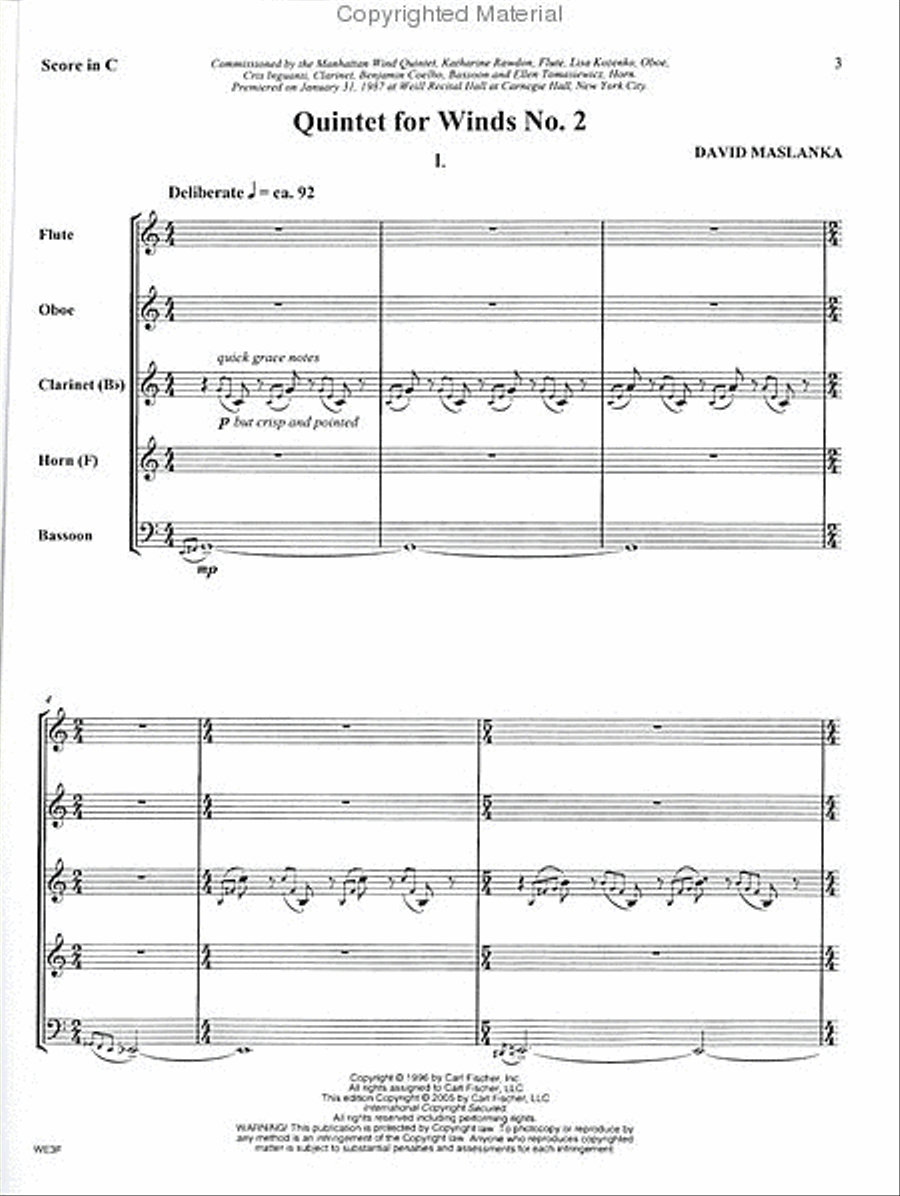
By David MaslankaWritten in 1986 for the Manhattan Wind Quintet, this dynamic piece in three movements encompasses several moods that range from aggressiveness to placidity and etherealness. A technically demanding piece, the first movement is filled with exciting short phrases that come together in a fugual section. The second movement is both peaceful and emotional, with a profound sense of mystery. Finally, the third movement, a chaconne, features a continuous set of variations over a brief repeated harmonic pattern. The movement ends with a chorale-like coda that summarizes the entire piece.Quintet for Winds No. 2 was written in 1986 for the Manhattan WindQuintet, which gave the premiere performance in January 1987 at theWeill Recital Hall in New York City. Like Quintet for Winds No. 1, it is inthree movements, yet the progression of attitudes is quite different.The movement through the entire piece shifts by degrees from anassertive, technically demanding character to music that is quite placidand ethereal.The first movement is, for the most part, aggressive and driving. Itsexposition consists of a number of relatively brief ideas sharply intercut.The center of the movement is a complete fugue employing anumber of traditional devices including retrograde, inversion, andretrograde-inversion of the subject, rhythmic augmentation and diminution,and stretto. The recapitulation consists of a quiet and thoughtfulreworking of the introduction to the movement and an evolutionof one of the short ideas from the exposition.The second movement has an underlying attitude of mystery andelusiveness. The pleasant and lulling quality of the opening gives wayto a much more emotional and demanding music. The recapitulationfurther evolves the soothing character of the beginning, and the codaaffects a mysterious disappearance.The third movement is a chaconne, a continuous set of variations overa brief repeated harmonic pattern. This radically simple harmonicscheme, laid out in whole notes, persists undisturbed until the coda.Above it unfold, a solo, a duet, a trio, then a drive to the movement’sclimactic point. The music then subsides to a restatement of the openingoboe solo, followed by a chorale-like coda that summarizes theentire piece.
Details
Summary
- Instrument:
- Bassoon B-Flat Clarinet Flute Horn Oboe
- Ensembles:
- Woodwind Quintet
- Genres:
- 20th Century
- Composers:
- David Maslanka
- Publishers:
- Carl Fischer Music
- UPC:
- 798408056933
- ISBN:
- 9780825856938
- Format:
- Score Set of Parts Score and Parts
- Item types:
- Physical
- Artist:
- David Maslanka
- Usages:
- School and Community
- Main Key:
- C major
- Number of Pages:
- 144
- Size:
- 9 x 12 inches
- Shipping Weight:
- 1.31 pounds
Detailed Description
SKU: CF.WE3
For Flute, Oboe, Clarinet, Horn and Bassoon. Composed by David Maslanka. This edition: saddle-wire stitch. Sws. Score and parts. With Standard notation. 144 pages. Duration 0:20:00. Carl Fischer Music #WE3. Published by Carl Fischer Music (CF.WE3).ISBN 9780825856938. UPC: 798408056933. 9 x 12 inches. Key: C major.
Written in 1986 for the Manhattan Wind Quintet, this dynamic piece in three movements encompasses several moods that range from aggressiveness to placidity and etherealness. A technically demanding piece, the first movement is filled with exciting short phrases that come together in a fugual section. The second movement is both peaceful and emotional, with a profound sense of mystery. Finally, the third movement, a chaconne, features a continuous set of variations over a brief repeated harmonic pattern. The movement ends with a chorale-like coda that summarizes the entire piece.
Quintet for Winds No. 2 was written in 1986 for the Manhattan WindQuintet, which gave the premiere performance in January 1987 at theWeill Recital Hall in New York City. Like Quintet for Winds No. 1, it is inthree movements, yet the progression of attitudes is quite different.The movement through the entire piece shifts by degrees from anassertive, technically demanding character to music that is quite placidand ethereal.The first movement is, for the most part, aggressive and driving. Itsexposition consists of a number of relatively brief ideas sharply intercut.The center of the movement is a complete fugue employing anumber of traditional devices including retrograde, inversion, andretrograde-inversion of the subject, rhythmic augmentation and diminution,and stretto. The recapitulation consists of a quiet and thoughtfulreworking of the introduction to the movement and an evolutionof one of the short ideas from the exposition.The second movement has an underlying attitude of mystery andelusiveness. The pleasant and lulling quality of the opening gives wayto a much more emotional and demanding music. The recapitulationfurther evolves the soothing character of the beginning, and the codaaffects a mysterious disappearance.The third movement is a chaconne, a continuous set of variations overa brief repeated harmonic pattern. This radically simple harmonicscheme, laid out in whole notes, persists undisturbed until the coda.Above it unfold, a solo, a duet, a trio, then a drive to the movement’sclimactic point. The music then subsides to a restatement of the openingoboe solo, followed by a chorale-like coda that summarizes theentire piece.
Song List
I.
II.
III.
Similar Sheet Music & Digital Downloads
- More by this Composer:
- David Maslanka David Maslanka B-Flat Clarinet David Maslanka E-Flat Clarinet David Maslanka Bass Clarinet
- Instrument:
- Woodwinds Bassoon Woodwinds Clarinet B-Flat Clarinet Woodwinds Flute Brass Horn Woodwinds Oboe
- Artists:
- David Maslanka
- Ensemble:
- Woodwind Quintet
- Publisher:
- Carl Fischer Music