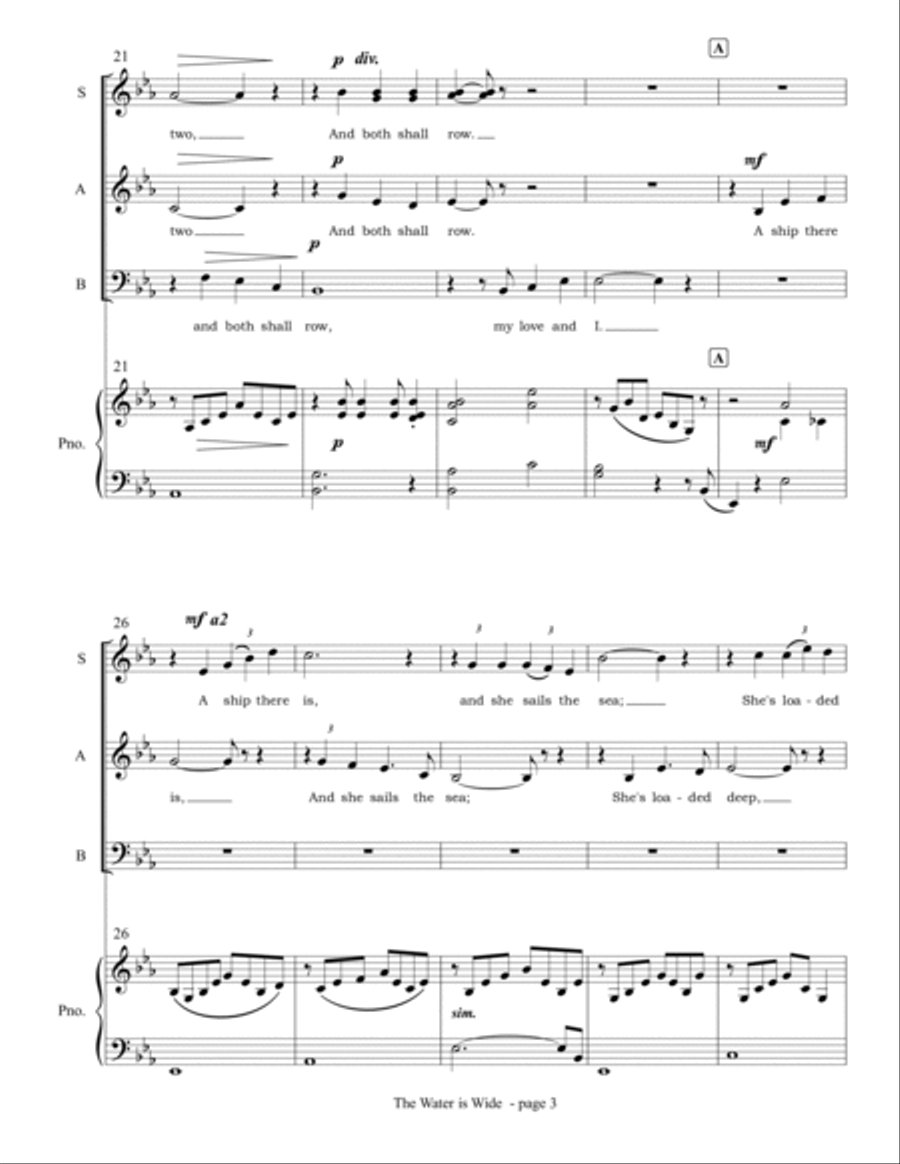
The Water is Wide (SAB choir and piano) by Traditional 3-Part - Digital Sheet Music
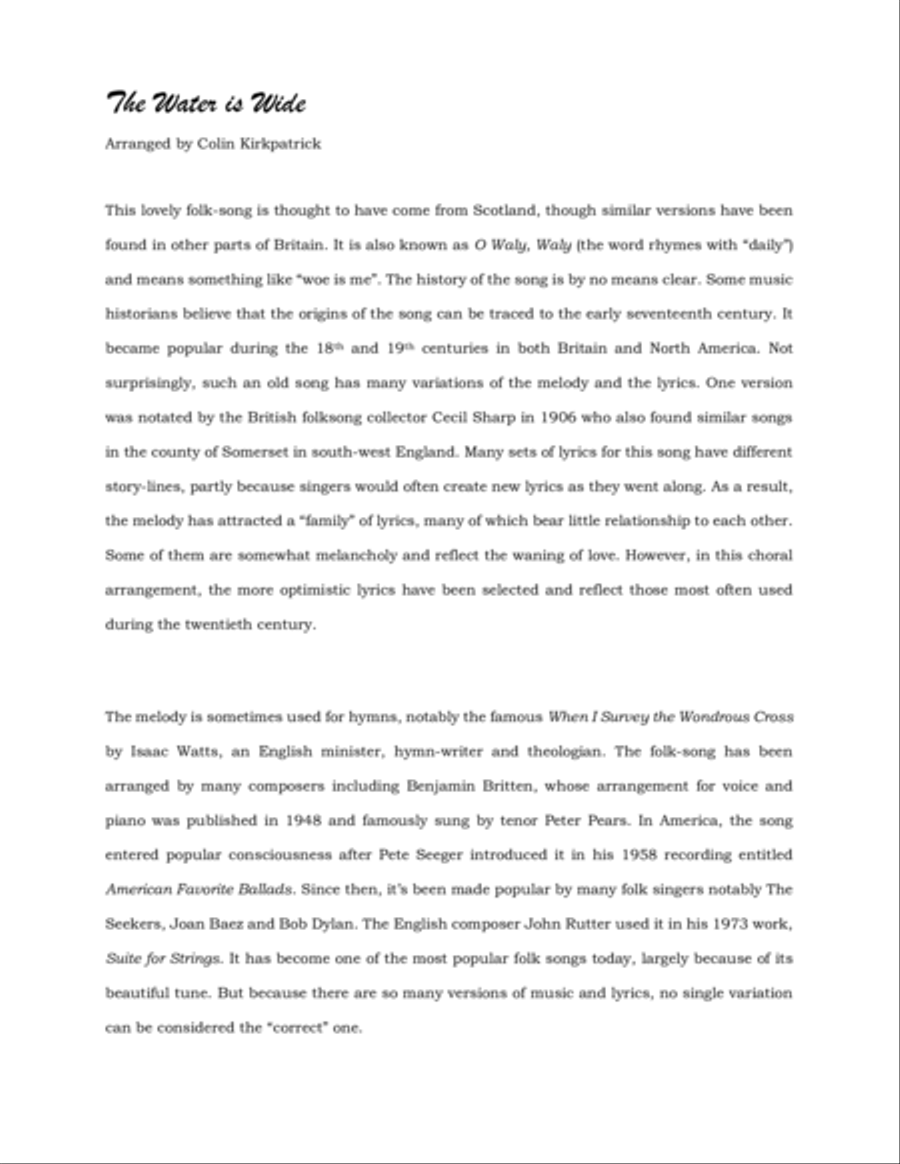
By TraditionalThis lovely folksong is thought to have come from Scotland, though similar versions have been recorded in other parts of Britain. The song is also known as O Waly, Waly which means something like “woe is me”. For such an old song, it is not surprising that there are many variations of the lyrics. An early version of the modern lyrics was consolidated by the British folksong collector Cecil Sharp in 1906, using multiple older sources in southern England. There are many sets of lyrics with different story-lines. This was because in the past, performers would often create new lyrics for the song. This melody has attracted an entire "family" of lyrics many of which bear little relationship to each other. The words used in this choral arrangement reflect the popular lyrics used during the twentieth century. The song was arranged for voice and piano in 1948 by British composer Benjamin Britten but in more recent times, was made popular by many folk singers notably Joan Baez and Bob Dylan. It has become one of the most popular folk songs today, largely because of its beautiful tune. But as with the lyrics, there are many variations on the melody with the result that no single variation can be considered the “correct” one.This SAB arrangement by Colin Kirkpatrick is ideal for high school or college choir, especially if the tenor/bass section is a bit low on numbers. Each section of the choir has the melody line at some point and there are attractive and evocative counter-melodies. In the soprano part (which has one brief divisi section), the highest note is G5 (which occurs only once and safely approached) and the highest note in the alto part is C5 (in the middle of the treble staff). The bartione part lies between A flat 2 (bottom space in bass clef) and D3 (just above the staff). The piano part is an integral part of the arrangement and therefore essential. The music begins in E flat and modulates to C major. Running at just over three minutes, the work is sure to be popular with choir and audiences alike.
Details
Summary
- Instrument:
- Choir Piano Accompaniment
- Ensembles:
- 3-Part SAB Mixed Choir
- Genres:
- Early Music Folk Wedding Celtic Irish St. Patrick's Day
- Composers:
- Traditional
- Publishers:
- Colin Kirkpatrick Publications
- Series:
- ArrangeMe
- Format:
- Octavo
- Item types:
- Digital
- Level:
- Early Intermediate
- Artist:
- Traditional
- Usages:
- School and Community
- Number of Pages:
- 10
Detailed Description
SKU: A0.1264867
Composed by Traditional. Arranged by Colin Kirkpatrick. Celtic,Early Music,Folk,Irish,Wedding. Octavo. 10 pages. Colin Kirkpatrick Publications #857706. Published by Colin Kirkpatrick Publications (A0.1264867).This lovely folksong is thought to have come from Scotland, though similar versions have been recorded in other parts of Britain. The song is also known as O Waly, Waly which means something like “woe is me”. For such an old song, it is not surprising that there are many variations of the lyrics. An early version of the modern lyrics was consolidated by the British folksong collector Cecil Sharp in 1906, using multiple older sources in southern England. There are many sets of lyrics with different story-lines. This was because in the past, performers would often create new lyrics for the song. This melody has attracted an entire "family" of lyrics many of which bear little relationship to each other. The words used in this choral arrangement reflect the popular lyrics used during the twentieth century.
The song was arranged for voice and piano in 1948 by British composer Benjamin Britten but in more recent times, was made popular by many folk singers notably Joan Baez and Bob Dylan. It has become one of the most popular folk songs today, largely because of its beautiful tune. But as with the lyrics, there are many variations on the melody with the result that no single variation can be considered the “correct” one.
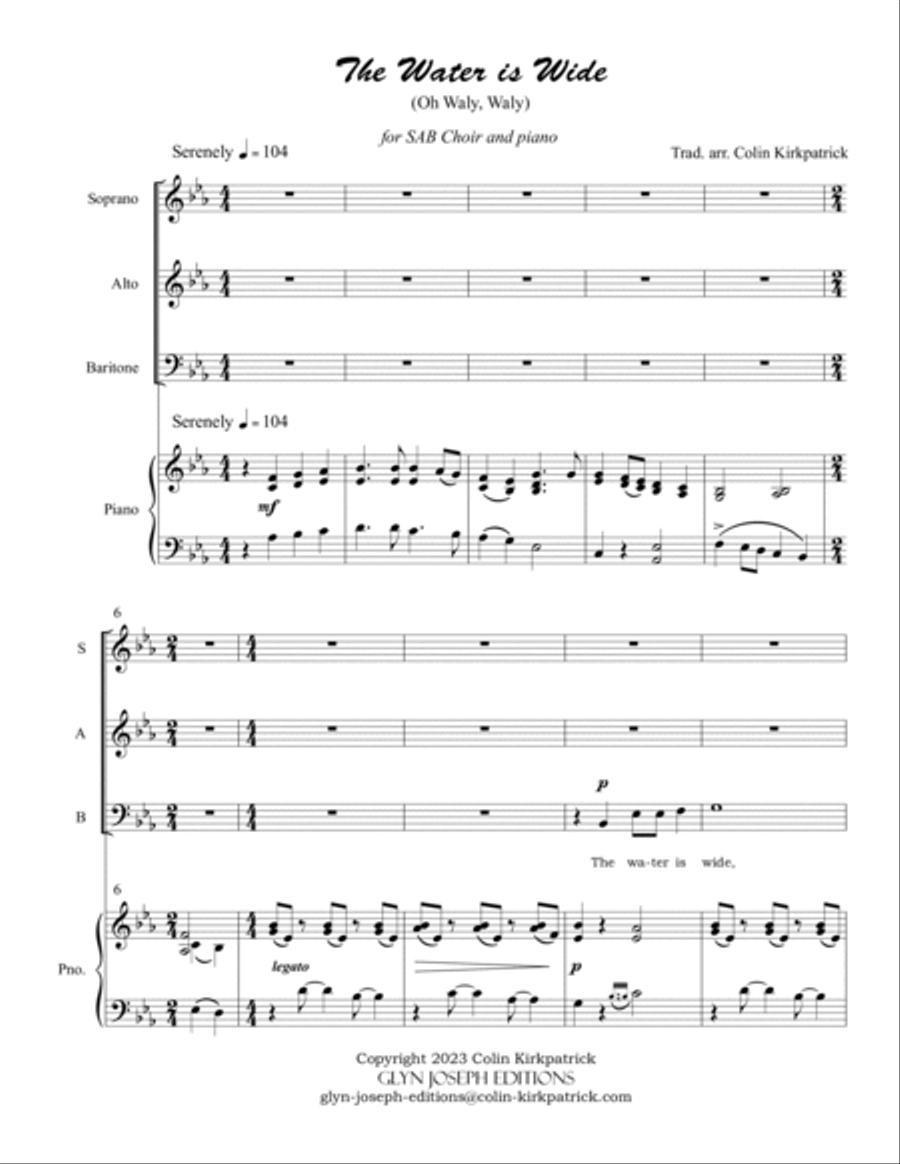
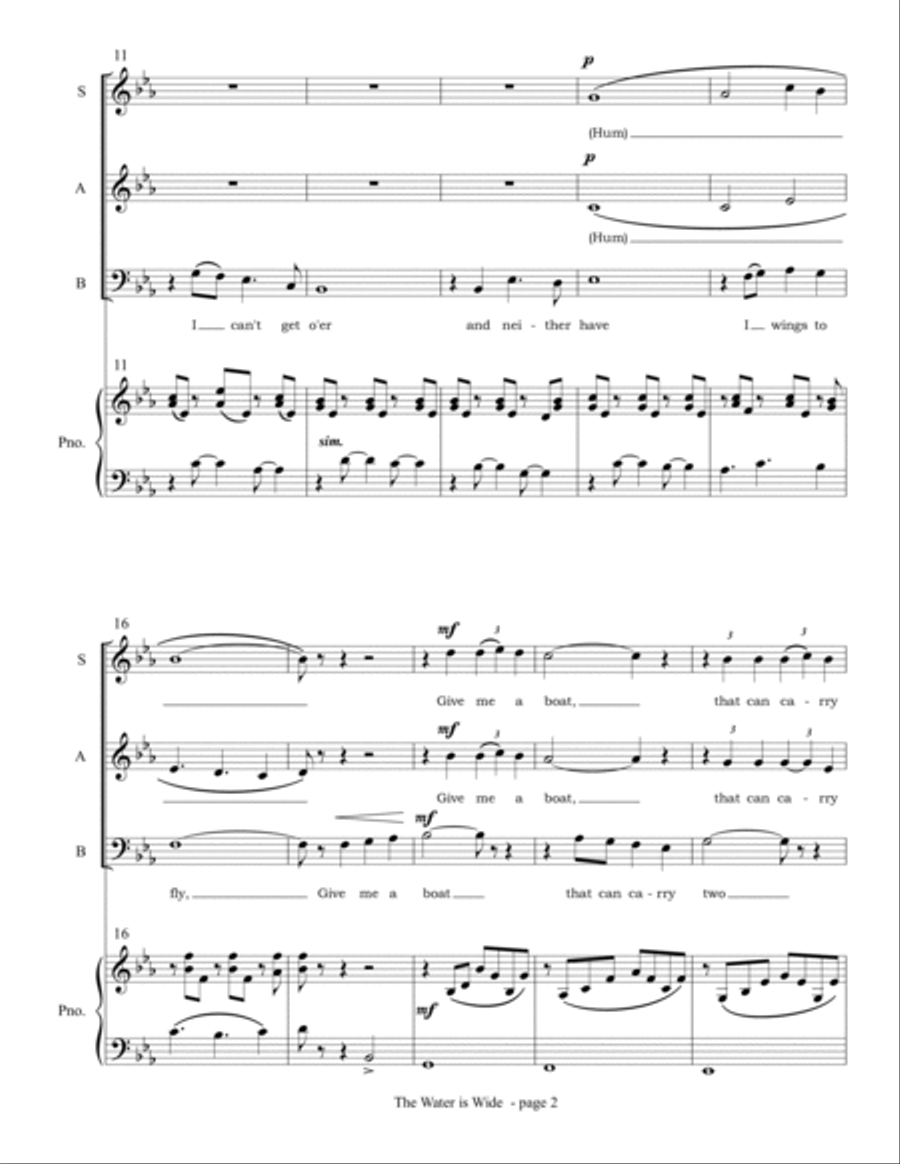
This SAB arrangement by Colin Kirkpatrick is ideal for high school or college choir, especially if the tenor/bass section is a bit low on numbers. Each section of the choir has the melody line at some point and there are attractive and evocative counter-melodies. In the soprano part (which has one brief divisi section), the highest note is G5 (which occurs only once and safely approached) and the highest note in the alto part is C5 (in the middle of the treble staff). The bartione part lies between A flat 2 (bottom space in bass clef) and D3 (just above the staff). The piano part is an integral part of the arrangement and therefore essential. The music begins in E flat and modulates to C major. Running at just over three minutes, the work is sure to be popular with choir and audiences alike.
About ArrangeMe
This product was created by a member of ArrangeMe, Hal Leonard's self-publishing community for independent composers, arrangers, and songwriters. Discover unique arrangements of popular titles and original compositions from diverse creators. The length, difficulty, and pricing are determined by the arranger or composer.
About Digital Downloads
Digital Downloads let you instantly access sheet music on your computer, tablet, or mobile device. Print your sheet music anywhere, anytime, or play it straight from your device—no internet connection is required after download.
Each Digital Download includes a watermark with your name, purchase date, and the number of copies purchased. You may only print or use the number of copies purchased. Redistribution or unauthorized printing is prohibited.
Similar Sheet Music & Digital Downloads
- More by this Composer:
- Traditional Traditional Piano Traditional Piano Accompaniment Traditional Violin
- ArrangeMe:
- Colin Kirkpatrick Publications
- Series:
- ArrangeMe
- Instrument:
- Vocal Choir Piano and Keyboard Piano Accompaniment
- Artists:
- Traditional
- Ensemble:
- 3-Part SAB Mixed Choir
- Publisher:
- Colin Kirkpatrick Publications